
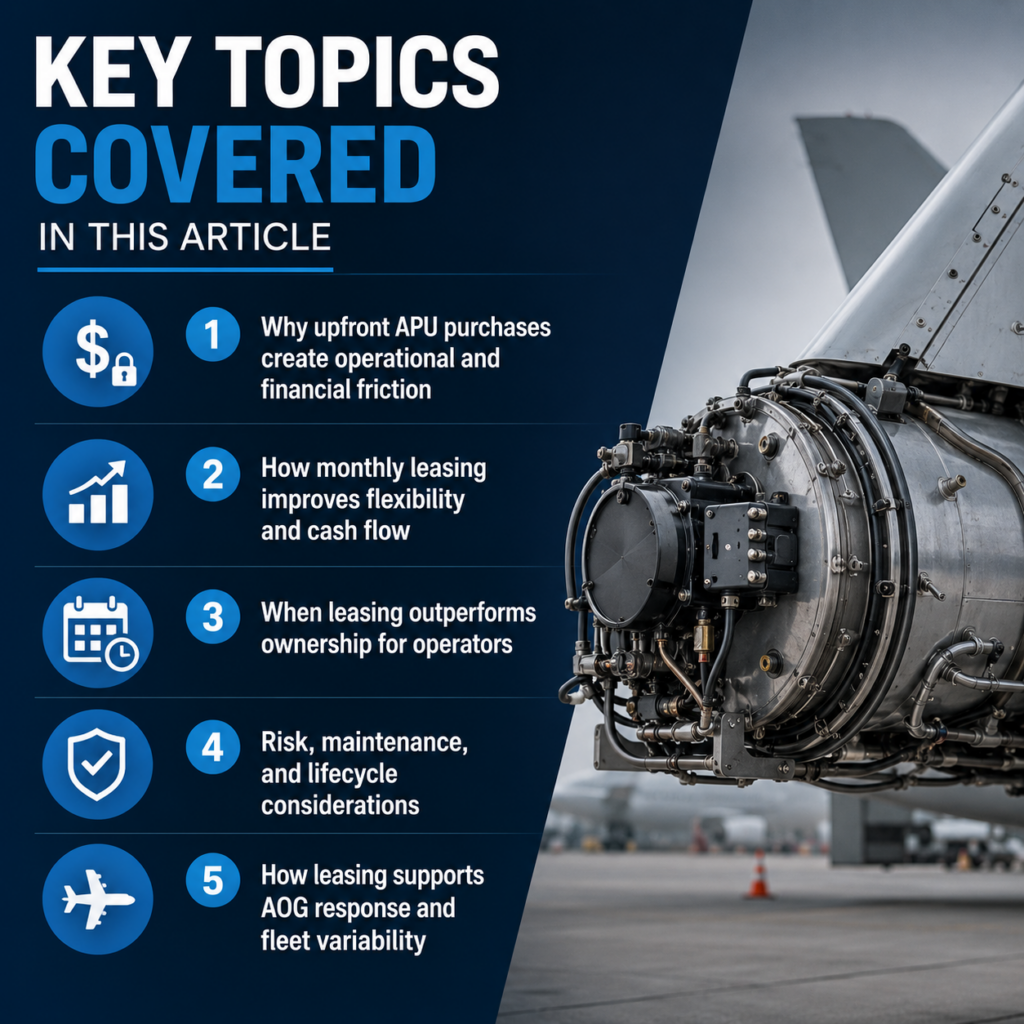
Key Topics Covered in This Article
- Why upfront APU purchases create operational and financial friction
- How monthly leasing improves flexibility and cash flow
- When leasing outperforms ownership for operators
- Risk, maintenance, and lifecycle considerations
- How leasing supports AOG response and fleet variability
For many operators, the default assumption is simple:
If you need an APU, you buy one.
On paper, ownership appears straightforward. You control the asset, avoid recurring payments, and treat it as a long-term investment.
In practice, however, APU ownership introduces a different set of challenges.
Aircraft operations are not static. Maintenance schedules shift, failures happen unexpectedly, and fleet requirements change over time.
Because of this, committing capital to a fixed APU asset is not always the most efficient or flexible approach.
Monthly leasing changes that dynamic.
The Problem with Upfront APU Purchases
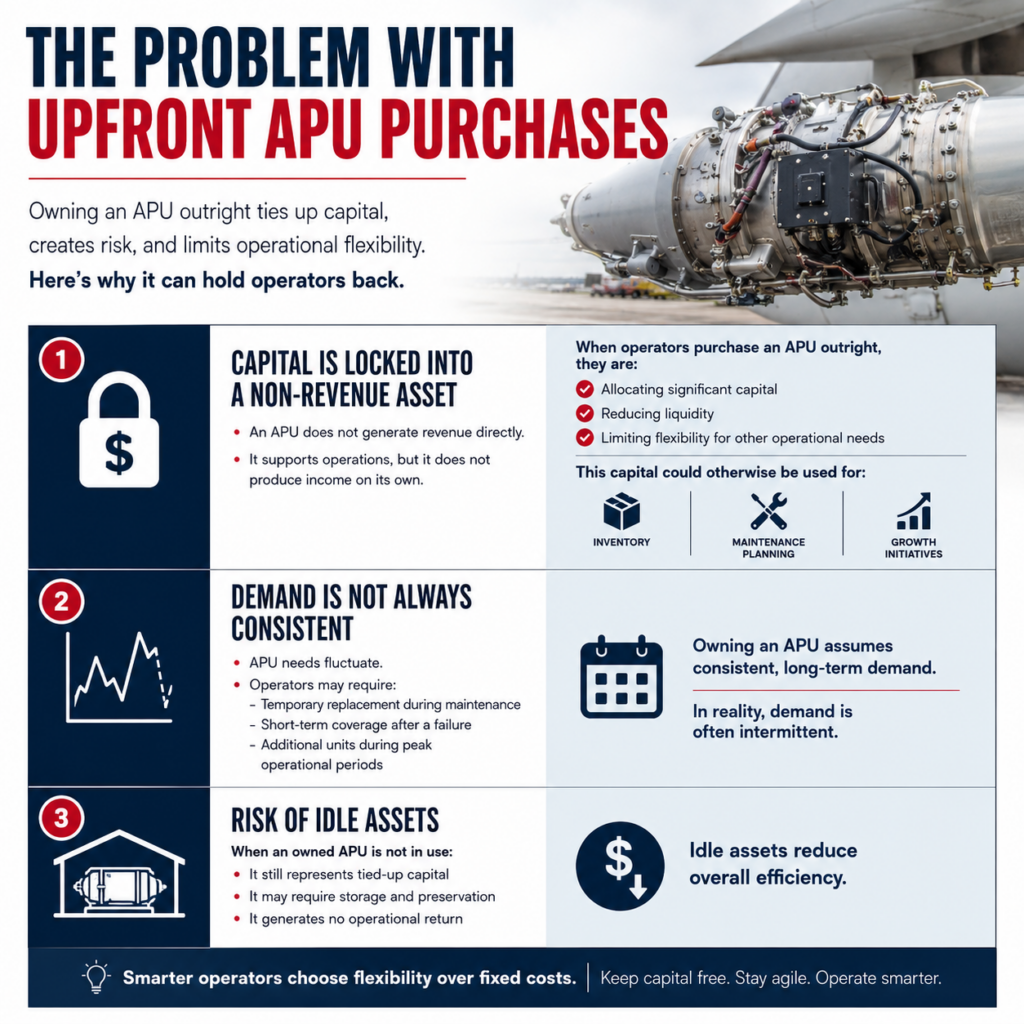
Capital Is Locked into a Non-Revenue Asset
An APU does not generate revenue directly.
It supports operations, but it does not produce income on its own.
When operators purchase an APU outright, they are:
- Allocating significant capital
- Reducing liquidity
- Limiting flexibility for other operational needs
This capital could otherwise be used for:
- Inventory
- Maintenance planning
- Growth initiatives
Demand Is Not Always Consistent
APU needs fluctuate.
Operators may require:
- Temporary replacement during maintenance
- Short-term coverage after a failure
- Additional units during peak operational periods
Owning an APU assumes consistent, long-term demand.
In reality, demand is often intermittent.
Risk of Idle Assets
When an owned APU is not in use:
- It still represents tied-up capital
- It may require storage and preservation
- It generates no operational return
Idle assets reduce overall efficiency.
How Monthly Leasing Improves Flexibility
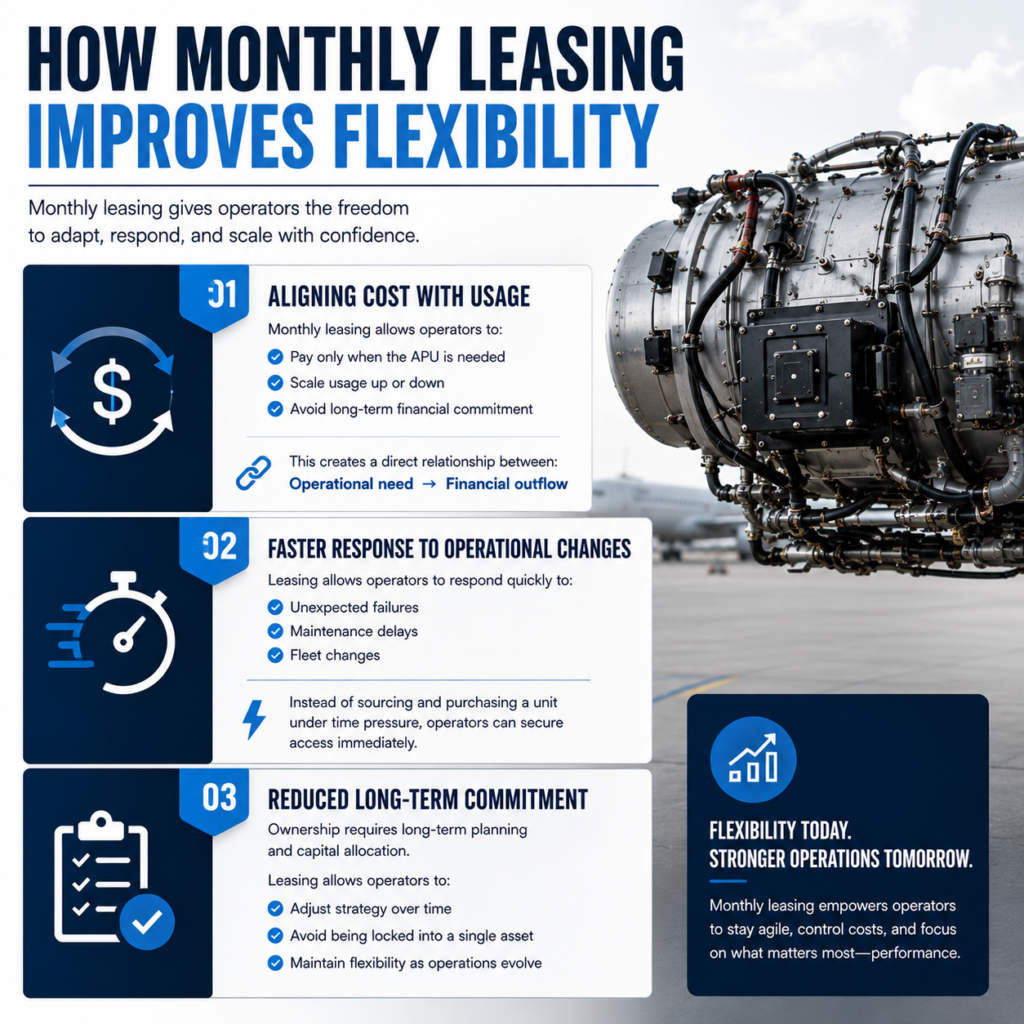
Aligning Cost with Usage
Monthly leasing allows operators to:
- Pay only when the APU is needed
- Scale usage up or down
- Avoid long-term financial commitment
This creates a direct relationship between:
- Operational need
- Financial outflow
Faster Response to Operational Changes
Leasing allows operators to respond quickly to:
- Unexpected failures
- Maintenance delays
- Fleet changes
Instead of sourcing and purchasing a unit under time pressure, operators can secure access immediately.
Reduced Long-Term Commitment
Ownership requires long-term planning and capital allocation.
Leasing allows operators to:
- Adjust strategy over time
- Avoid being locked into a single asset
- Maintain flexibility as operations evolve
Leasing vs Ownership in AOG Scenarios
When an aircraft goes AOG due to APU failure, time becomes the primary constraint.
Ownership Limitations
- A spare unit may not be available
- Procurement timelines can be long
- Capital decisions must be made under pressure
Leasing Advantages
- Immediate access to a serviceable unit
- No need for upfront purchase approval
- Faster return to service
In AOG situations, speed matters more than ownership.
Leasing provides that speed.
Maintenance and Lifecycle Considerations
Ownership Shifts Responsibility
When an operator owns an APU, they are responsible for:
- Maintenance planning
- Repair costs
- Overhaul decisions
- Lifecycle management
This introduces:
- Cost variability
- Resource requirements
- Technical management overhead
Leasing Reduces Lifecycle Burden
With leasing, many of these responsibilities are reduced or shifted.
Operators benefit from:
- Predictable monthly costs
- Reduced exposure to major repair events
- Access to serviceable, compliant units
Instead of managing the full lifecycle, operators can focus on operations.
Financial Predictability and Cost Control
Upfront Purchase = Unpredictable Costs
Ownership introduces variability:
- Unexpected repairs
- Overhaul timing
- Component failures
These costs are often:
- Difficult to forecast
- Significant when they occur
Monthly Leasing = Predictable Spend
Leasing provides:
- Consistent monthly cost structure
- Easier budgeting
- Reduced financial surprises
This allows operators to:
- Plan more effectively
- Allocate resources with greater confidence
Fleet Variability and Changing Requirements
Aircraft fleets are not static.
Operators may:
- Add or remove aircraft
- Change routes or utilization
- Adjust operational strategy
Ownership Creates Rigidity
Owning APUs ties operators to:
- Specific configurations
- Fixed asset inventory
- Long-term commitments
Leasing Supports Adaptability
Leasing allows operators to:
- Adjust APU usage as fleet needs change
- Avoid overcommitting to specific assets
- Stay aligned with operational demand
This flexibility becomes increasingly valuable as operations scale or shift.
When Buying Still Makes Sense
Leasing is not always the best option.
There are scenarios where ownership is appropriate.
High Utilization, Stable Operations
Operators with:
- Consistent APU demand
- Stable fleet composition
- Long-term planning horizon
May benefit from ownership.
Long-Term Cost Optimization
Over extended periods, ownership may:
- Reduce total cost
- Provide asset value retention
However, this assumes:
- Predictable usage
- No major disruptions
- Strong maintenance management
The Hybrid Approach: Leasing + Ownership
Many operators use a combination of both strategies.
Core Fleet = Owned APUs
- Supports stable, predictable operations
Variable Demand = Leased APUs
- Covers maintenance gaps
- Handles unexpected failures
- Supports short-term needs
This approach balances:
- Cost efficiency
- Operational flexibility
Risk Management and Operational Stability
APU availability directly impacts:
- Dispatch reliability
- Turnaround times
- Passenger experience
Ownership Risk
- Exposure to failure events
- Capital tied up in assets
- Limited flexibility
Leasing Advantage
- Access to replacement units
- Reduced downtime risk
- Increased operational stability
Leasing acts as a buffer against uncertainty.
Conclusion
Leasing an APU on a monthly basis is not just a financial decision.
It is an operational strategy.
It allows operators to:
- Maintain flexibility
- Reduce capital constraints
- Respond quickly to disruptions
- Simplify maintenance management
While ownership still has a place in stable, high-utilization environments, many operators find that leasing provides a more adaptable and efficient solution.
In an industry where timing, reliability, and cost control all matter, flexibility often outweighs fixed ownership.
Air Viper Support for APU Operations
For operators evaluating leasing versus ownership, having access to both options creates a clear advantage.
Air Viper supports operators and lessors with both APU sales and monthly leasing options, allowing teams to choose the approach that best aligns with their operational needs.
Monthly agreements provide flexibility during maintenance cycles, unexpected failures, or fleet changes, while purchasing options support long-term planning and asset ownership strategies.
With access to certified, traceable units and flexible deployment timelines, operators can maintain continuity without being constrained by capital or procurement delays.
In environments where adaptability and uptime are critical, having both leasing and purchasing pathways available supports stronger operational outcomes