
1. Key Topics Covered in This Article
- Why APU requirements vary by aircraft type
- How aircraft size, mission, and systems drive APU design
- Differences between commercial, business, and military APU needs
- Operational and cost implications of APU selection
- Maintenance, sourcing, and fleet strategy considerations
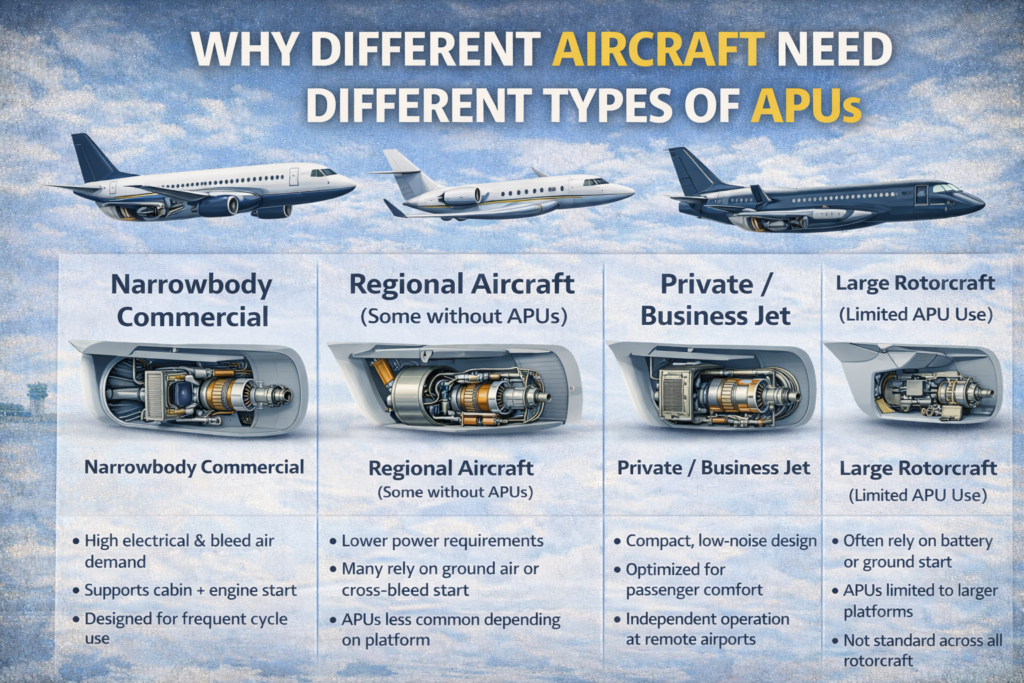
Not all aircraft operate the same way.
A narrowbody jet turning 6 legs per day has very different operational demands than a long-haul widebody, a business jet, or a military aircraft operating in remote conditions.
Because of this, the Auxiliary Power Unit (APU) is not a one-size-fits-all system.
The type of APU installed on an aircraft is driven by a combination of:
- Power requirements
- Mission profile
- Operating environment
- Cost structure
- System integration
Choosing the wrong type of APU or misunderstanding its role can lead to inefficiencies, increased maintenance costs, and operational limitations.
2. Aircraft Size Drives Power Requirements
One of the primary reasons different aircraft require different APUs is simple: power demand.
Large Aircraft Require High Output
Widebody aircraft must support:
- Large cabins
- Extensive avionics systems
- Multiple environmental control systems
This requires APUs with:
- Higher electrical output
- Greater pneumatic capacity
- Stronger thermal tolerance
These units are larger, more powerful, and more complex.
Smaller Aircraft Require Efficiency
Business jets and regional aircraft operate with:
- Smaller cabins
- Lower system loads
- Shorter duty cycles
Their APUs are:
- Smaller
- More fuel-efficient
- Optimized for quiet operation
Oversizing an APU in a smaller aircraft would increase fuel burn and maintenance costs without adding value.
3. Mission Profile Changes Everything
How an aircraft is used has a direct impact on the type of APU it needs.
High-Frequency Operations (Narrowbody Airlines)
Aircraft flying multiple short routes per day:
- Start and stop the APU frequently
- Require fast, reliable cycles
- Prioritize turnaround speed
These APUs are designed for:
- High cycle durability
- Rapid start capability
- Consistent performance under repetitive use
Long-Haul Operations (Widebody Aircraft)
Aircraft on long international routes:
- Use the APU less frequently
- Operate for longer continuous periods when active
These APUs prioritize:
- Stability over long durations
- Fuel efficiency at sustained loads
- Reduced in-flight dependency
Private and Business Aviation
Business jets focus heavily on:
- Passenger comfort
- Noise reduction
- Cabin experience
Their APUs are designed to be:
- Quiet
- Smooth-running
- Efficient during ground operations
4. Operating Environment Impacts APU Design
Aircraft do not all operate in controlled airport environments.
Remote and Undeveloped Locations
Aircraft operating in:
- Remote airfields
- Military bases
- Developing regions
Require APUs that:
- Operate independently of ground support
- Handle extreme temperatures and conditions
- Provide reliable power without external systems
Major Airport Environments
Aircraft operating in major hubs:
- Often have access to GPUs and ground infrastructure
This allows:
- Reduced APU usage
- Lower fuel consumption
- More flexibility in APU design priorities
Extreme Weather Conditions
APUs must be designed for:
- High heat environments
- Cold starts in freezing conditions
- Variable altitude operations
Different aircraft require APUs optimized for their typical operating environments.
5. System Integration and Aircraft Design
APUs are not standalone systems. They are integrated into the aircraft’s overall design.
Electrical System Requirements
Aircraft with more advanced avionics require:
- Higher electrical output
- Stable power delivery
Pneumatic System Needs
Aircraft that rely heavily on bleed air systems require:
- Stronger air compression capability
- Reliable pressure output
Space and Weight Constraints
Smaller aircraft:
- Have limited space for APU installation
- Require lightweight designs
Larger aircraft:
- Can accommodate larger, more powerful units
The APU must fit within the aircraft’s physical and system constraints.
6. Commercial vs Military Requirements
Military aircraft operate under entirely different conditions compared to commercial aircraft.
Military APU Needs
- Must function in austere environments
- Require higher durability
- Often operate without ground support
- May include additional redundancies
Commercial APU Needs
- Focus on efficiency and cost control
- Operate within structured airport systems
- Prioritize reliability and lifecycle cost
Military APUs are designed for independence and resilience, while commercial APUs are optimized for efficiency and consistency.
7. Cost Structure and Operational Strategy
APU selection is not just technical. It is financial.
Fuel Consumption
Larger APUs:
- Consume more fuel
- Increase operating costs
Smaller APUs:
- Improve efficiency
- Reduce cost per cycle
Maintenance Costs
High-output APUs:
- Experience more thermal stress
- Require more intensive maintenance
High-cycle APUs:
- Wear faster due to frequent use
Operators must balance:
- Power requirements
- Maintenance frequency
- Cost of operation
Ownership vs Flexibility
Some operators prioritize:
- Owning APUs for long-term cost control
Others prioritize:
- Flexibility through short-term solutions
Different aircraft types often require different approaches to sourcing and availability.
8. Maintenance and Lifecycle Differences
The type of APU directly impacts maintenance planning.
High-Cycle APUs
- Found in short-haul aircraft
- Require frequent inspections
- Experience faster wear
Low-Cycle, High-Duration APUs
- Found in long-haul aircraft
- Operate for longer continuous periods
- Require different maintenance intervals
Specialized APUs
- Found in military or unique aircraft
- May require specialized parts and support
Understanding these differences is critical for:
- Maintenance scheduling
- Spare unit planning
- Minimizing downtime
9. Fleet-Level Implications
For operators managing multiple aircraft types, APU variation becomes a strategic consideration.
Mixed Fleets
Operators must manage:
- Multiple APU models
- Different maintenance requirements
- Varying spare part inventories
Standardized Fleets
Operators benefit from:
- Simplified maintenance
- Reduced inventory complexity
- More predictable costs
Fleet composition directly impacts APU strategy.
10. Why This Matters for Sourcing and Availability
When an APU fails or requires removal, the replacement process is not always straightforward.
Because APUs are:
- Aircraft-specific
- Configuration-dependent
- Certification-sensitive
Sourcing the correct unit requires:
- Accurate part matching
- Verified documentation
- Compliance with regulatory standards
In time-sensitive situations, delays in sourcing can lead to:
- Aircraft-on-ground (AOG) events
- Operational disruption
- Revenue loss
Having access to the right type of APU at the right time becomes a critical operational factor.
11. Conclusion
Different aircraft require different APUs because their operational realities are different.
Factors such as:
- Aircraft size
- Mission profile
- Operating environment
- System design
- Cost structure
All influence the type of APU needed.
Understanding these differences allows operators to:
- Optimize performance
- Control costs
- Reduce downtime
- Improve operational flexibility
The APU is not just a supporting component. It is a system that must align precisely with the aircraft it serves.
Air Viper Support for APU Operations
For operators managing diverse fleets and varying APU requirements, access to the right unit is critical.
Air Viper supports operators and lessors with both APU sales and leasing options, providing flexibility across different aircraft types and operational scenarios. Whether the need is long-term ownership or short-term coverage, access to certified, traceable units ensures compatibility and compliance.
Flexible leasing options allow operators to respond quickly to maintenance events or unexpected failures, while purchasing options provide long-term stability for core fleet assets.
In environments where timing, documentation, and reliability all matter, having access to both pathways simplifies APU management and keeps operations moving.