
Key Topics Covered in This Article
- Why documentation determines the value of a borescope inspection
- How inspection records create usable evidence for technical review
- The engine, model, serial, date, location, and scope details that should be recorded
- Why inspected and inaccessible engine areas must be clearly identified
- The importance of sharp, well-lit photographs from useful angles
- How video helps show a finding’s location, context, and surrounding condition
- When measurements are useful and why their limitations should be disclosed
- How to write specific, objective descriptions of internal engine findings
- Comparing visible conditions with maintenance manuals and engineering criteria
- The role of documentation in purchases, lease returns, shipping, insurance, and disputes
- How poor labeling, vague notes, and incomplete records create unnecessary risk
- How Air Viper provides organized photos, video, reporting, and accountable inspection support
- Air Viper’s experience with CF6, CFM56, Trent 700, and other major engine platforms
- How clear documentation helps stakeholders make better maintenance and asset decisions
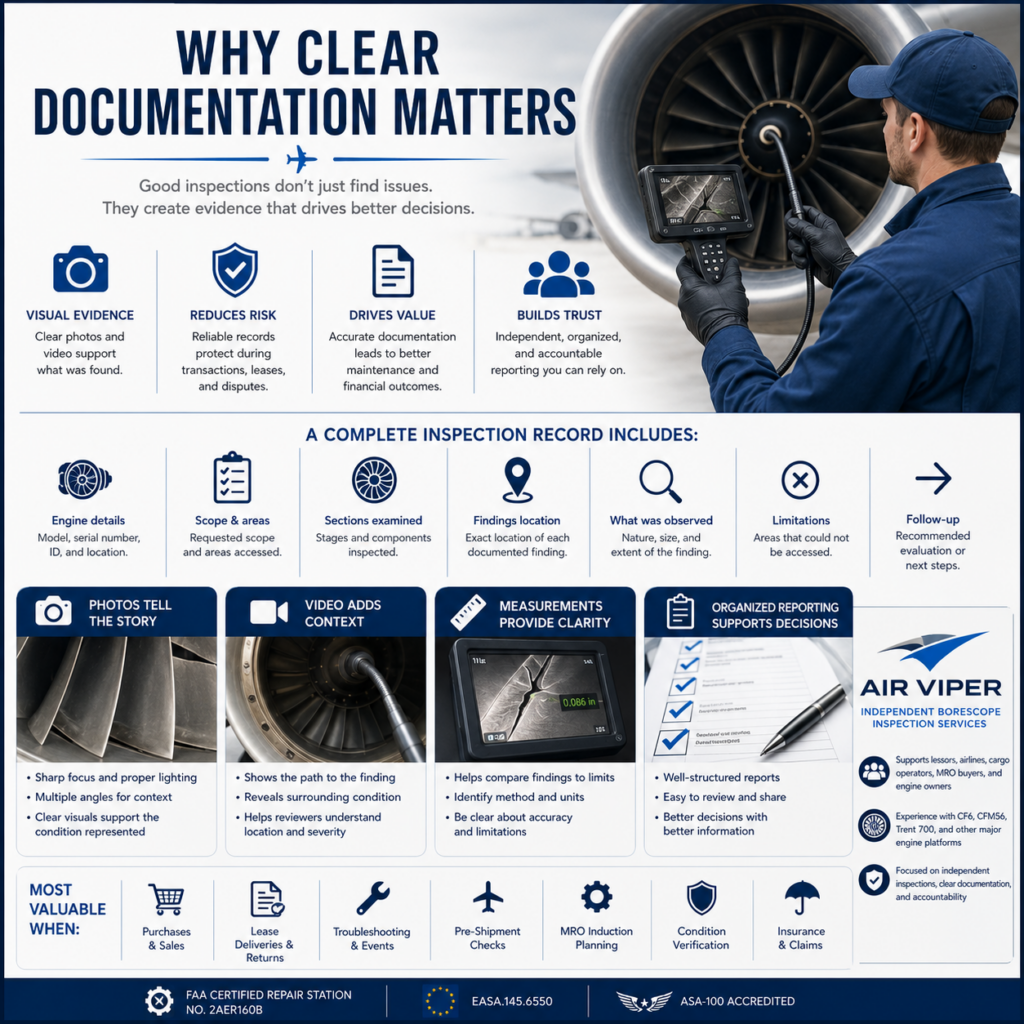
The value of an aircraft engine borescope inspection depends on more than the inspector’s ability to identify visible damage. The inspection must also create a clear, organized, and defensible record of what was observed.
Finding a crack, rub mark, deposit, burned area, damaged blade, or other internal condition is only part of the job. The inspector must document the finding well enough that another qualified person can understand where it was located, what it looked like, how it was evaluated, and whether additional action may be required.
Without strong documentation, even a technically accurate inspection can lose much of its practical value.
Poorly focused photographs, incomplete video, vague descriptions, missing engine information, or unlabeled findings can create uncertainty instead of resolving it. These weaknesses may become especially important during an engine purchase, lease return, insurance review, maintenance discussion, warranty matter, or dispute between parties.
Air Viper, LLC focuses on clear documentation and accountability throughout the borescope inspection process. By creating organized visual records and written findings, Air Viper helps lessors, airlines, cargo operators, MRO buyers, engine owners, and other aviation stakeholders make more informed decisions.
A Borescope Inspection Must Produce Usable Evidence
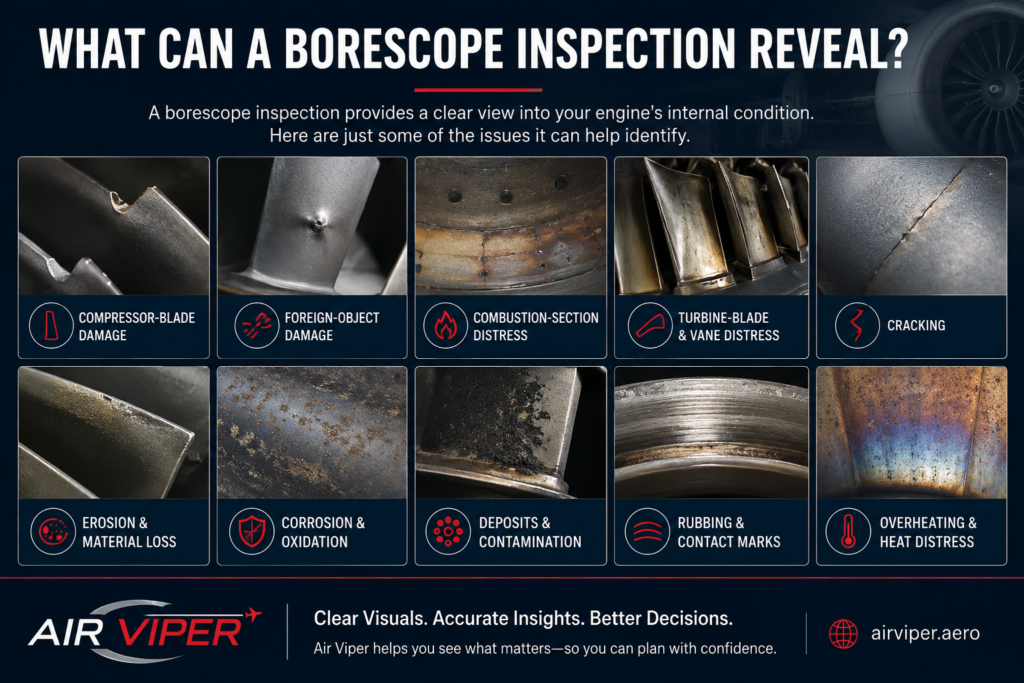
A borescope inspection allows qualified personnel to look inside areas of an aircraft engine that cannot be seen during a normal external examination.
The inspector may examine accessible parts of the:
- Fan
- Low-pressure compressor
- High-pressure compressor
- Combustion section
- High-pressure turbine
- Low-pressure turbine
- Turbine nozzles and vanes
- Blades, seals, cases, and gas-path components
The inspection may reveal visible cracking, erosion, corrosion, deposits, impact damage, rubbing, oxidation, coating loss, burning, deformation, or missing material.
However, the discovery of a finding does not automatically create a complete inspection result.
A useful result requires evidence.
That evidence may include photographs, video, measurements, written descriptions, stage and component identification, probe orientation, access details, and references to applicable maintenance or engineering criteria.
A report should allow another qualified reviewer to understand the finding without having been physically present during the inspection.
This is especially important because the final decision may not be made by the person operating the borescope. The images and report may be reviewed by an airline engineering department, a lessor’s technical representative, an MRO, an engine buyer, an insurer, an attorney, an OEM, or an independent consultant.
The documentation must therefore communicate clearly beyond the inspection site.
What a Complete Inspection Record Should Include
A professional borescope inspection record should identify the engine and establish the context in which the work was performed.
At a minimum, the documentation should include the engine inspected, its model, available identifying information, the date and location of the inspection, and the requested scope.
Depending on the assignment, identifying details may include:
- Engine manufacturer
- Engine model
- Engine serial number
- Aircraft registration or tail number
- Aircraft model
- Engine position
- Asset or inventory number
- Customer or operator information
- Work-order or reference number
These details help ensure that the images and findings are connected to the correct asset.
This may seem basic, but documentation errors can create serious confusion when several engines of the same model are being inspected, transferred, stored, or maintained at the same facility.
A report should also state why the inspection was performed.
The requested scope may involve:
- Pre-purchase due diligence
- Lease delivery
- Lease return
- Troubleshooting
- Foreign-object damage evaluation
- Pre-shipment verification
- Post-maintenance inspection
- MRO induction planning
- Insurance documentation
- Condition verification before installation
The purpose of the inspection helps reviewers understand the level of detail required and the importance of specific findings.
Clearly Identify the Areas Examined
A borescope inspection report should make it clear which areas were accessed and which sections or stages were examined.
A general statement that an engine was “borescoped” may not be sufficient.
The engine design, available access ports, condition of the equipment, inspection instructions, and requested scope may limit which areas can be viewed.
The report should identify the accessible sections examined, such as:
- Fan or booster stages
- Low-pressure compressor stages
- High-pressure compressor stages
- Combustion liner
- Fuel-nozzle areas
- High-pressure turbine stages
- Low-pressure turbine stages
- Nozzles, vanes, shrouds, and seals
When possible, the documentation should also identify individual stages and the approximate position of each finding.
For example, a finding described only as “compressor-blade damage” may be difficult to evaluate. A stronger description would identify the compressor section, stage, blade position, airfoil location, and visible characteristics.
Clear location information allows maintenance and engineering personnel to compare the finding with the correct criteria.
Document Areas That Could Not Be Accessed
A professional report should not imply that the entire engine was examined when access was limited.
Some areas may be difficult or impossible to view because of engine geometry, deposits, probe limitations, component position, blocked access ports, lighting conditions, or other restrictions.
These limitations should be documented clearly.
Examples may include:
- A stage could not be fully viewed
- A component surface was obscured by deposits
- The probe could not reach a specific area
- Engine rotation was restricted
- One or more access ports were unavailable
- Image quality was reduced by contamination
- Part of the component remained outside the camera angle
Documenting these limitations protects the integrity of the inspection.
It tells the customer exactly what the inspection did and did not establish. It also helps determine whether another inspection method, additional access, cleaning, engine rotation, or partial disassembly may be necessary.
A report that acknowledges limitations is generally more reliable than one that creates an unrealistic impression of complete visibility.
Why Image Quality Is Critical
Photographs and video are among the most important parts of a borescope inspection record.
A written description can explain what the inspector observed, but the visual evidence allows other qualified reviewers to see the condition directly.
The images should be clear enough to support the condition being represented.
Important aspects of image quality include:
- Focus
- Lighting
- Viewing angle
- Orientation
- Magnification
- Stability
- Color accuracy
- Surface visibility
- Component identification
A blurry or overexposed image may hide the edge of a crack or make ordinary surface features appear more severe than they are. A poorly positioned probe may fail to show the full extent of a damaged area.
Reflections from metallic surfaces can also create misleading visual patterns. The inspector must adjust lighting and camera position to reduce glare and capture the finding accurately.
When possible, multiple images should be taken from different angles. One image may show the general component location, while another provides a closer view of the finding.
This combination helps the reviewer understand both context and detail.
The Role of Video Documentation
Video can provide information that still images cannot.
A video sequence can show the route to the finding, the component’s surrounding area, the relationship between several blades or vanes, and the inspector’s movement through the engine section.
This is particularly useful when a finding is difficult to identify from a single photograph.
A well-recorded video may help demonstrate:
- The location of the finding within the engine
- Whether similar conditions exist on adjacent components
- The size and shape of the affected area
- The orientation of the crack, mark, or deposit
- The general condition of the surrounding stage
- How the finding appears under different angles and lighting
However, long, disorganized video files can also be difficult to review.
The inspector should capture relevant footage and organize it by engine section, stage, or finding. File names, timestamps, annotations, or a report index can help reviewers locate the necessary evidence quickly.
The goal is not simply to create a large amount of footage. The goal is to create useful footage.
Measurements and Scale
Some modern borescope systems include measurement capabilities that can help estimate the size, depth, length, or area of a visible finding.
Measurements may be important because maintenance criteria often depend on specific dimensions.
A crack, dent, nick, rub, or area of material loss may be acceptable in one location or size range but require further action in another.
When measurements are taken, the report should identify:
- The measurement method
- The measured dimension
- The units used
- The approximate measurement location
- Any equipment or access limitations
- Whether the measurement is estimated or verified
Measurements should not be presented with more precision than the inspection method can support.
Camera angle, probe distance, surface curvature, lighting, and calibration can affect accuracy. When measurement confidence is limited, the report should say so.
A clearly stated limitation is more useful than a number that appears exact but may not be reliable.
Written Descriptions Must Be Specific
Images and video should be supported by clear written descriptions.
Vague phrases such as “damage noted,” “blade issue,” or “possible crack” may not provide enough information for technical review.
A useful description should explain:
- What component was examined
- Where the finding was located
- What the finding looked like
- Its approximate size or extent
- Whether it appeared isolated or repeated
- Whether surrounding areas showed similar distress
- Whether additional review was recommended
For example, instead of writing “rub observed,” the report could identify a circumferential polished area on a specific blade-tip region or case surface.
Instead of writing “corrosion found,” the report could identify visible surface corrosion on a specific stage, including whether it appeared localized, widespread, light, or severe.
The description should remain objective.
The inspector should distinguish between what was directly observed and what may require further engineering interpretation. The report should not overstate conclusions that cannot be supported by visual evidence.
Comparing Findings With Maintenance and Engineering Criteria
A visible finding does not automatically mean an engine component is unserviceable.
Aircraft engine manufacturers and maintenance authorities establish inspection limits and evaluation criteria for many conditions, including:
- Cracks
- Nicks
- Dents
- Erosion
- Coating loss
- Rub marks
- Burning
- Corrosion
- Deposits
- Missing material
- Blade-tip wear
The acceptability of a finding may depend on its location, length, width, depth, direction, stage, component area, and proximity to critical features.
Clear documentation allows the finding to be compared with the correct maintenance or engineering criteria.
The report should identify the relevant maintenance manual, inspection procedure, engineering instruction, lease requirement, or other governing standard when appropriate.
In some cases, the inspector may document the finding and recommend review by:
- The engine manufacturer
- An airline engineering department
- An authorized repair station
- The lessor’s technical representative
- A qualified MRO
- Another approved engineering authority
The documentation creates the foundation for that review.
Documentation During Transactions and Lease Events
Clear borescope documentation is especially important when an engine is changing ownership, custody, location, or contractual responsibility.
During a purchase, the buyer may use the inspection record to verify that the engine’s visible internal condition matches the seller’s representation.
During a lease return, the lessor and operator may use the report to determine whether the engine meets the agreed return conditions.
During shipment, the documentation may establish the engine’s condition before it left one facility.
Without a clear condition record, the parties may later disagree about:
- Whether damage existed before the transaction
- When a finding occurred
- Whether the engine was properly represented
- Whether a condition was within limits
- Who is responsible for repair costs
- Whether the inspection scope was completed
Strong documentation cannot eliminate every dispute, but it can significantly improve the quality of the evidence available.
How Air Viper Supports Clear and Accountable Inspections
Air Viper provides independent borescope inspection services for lessors, airlines, cargo operators, MRO buyers, engine owners, and other aviation stakeholders.
The company focuses on producing inspection records that are organized, understandable, and useful for decision-making.
Air Viper’s approach emphasizes:
- Accurate engine identification
- Clearly defined inspection scope
- Thorough examination of accessible areas
- Detailed photographs and video
- Specific finding locations
- Objective written descriptions
- Documentation of inaccessible areas
- Organized reporting
- Recommended follow-up when appropriate
- Independent and impartial inspection support
Air Viper supports CF6, CFM56, Trent 700, and other major engine platforms.
With FAA Certified Repair Station No. 2AER160B, EASA.145.6550, ASA-100 accreditation, and more than 30 years of aviation maintenance experience, Air Viper brings technical knowledge and accountability to the inspection process.
Turning Inspection Findings Into Better Decisions
A borescope inspection should do more than identify possible damage.
It should create a reliable record that helps buyers, sellers, lessors, operators, maintenance teams, insurers, and engineers understand the visible internal condition of an engine.
Clear documentation connects the physical inspection to the decisions that follow.
It can support maintenance planning, transaction negotiations, repair estimates, engineering evaluation, lease compliance, insurance review, and responsibility determinations.
When images are clear, findings are properly labeled, limitations are disclosed, and reports are organized, the inspection becomes far more useful.
Air Viper helps aviation stakeholders turn internal engine observations into practical evidence through independent inspections, clear documentation, and accountable reporting.
For high-value aviation assets, the inspection is only as useful as the record it leaves behind.