
1. Key Topics Covered in This Article
- The main types of aircraft APUs and how they differ
- How APUs vary by aircraft size and mission
- Electric vs turbine-based APUs
- Military vs commercial APU configurations
- Maintenance, cost, and sourcing considerations
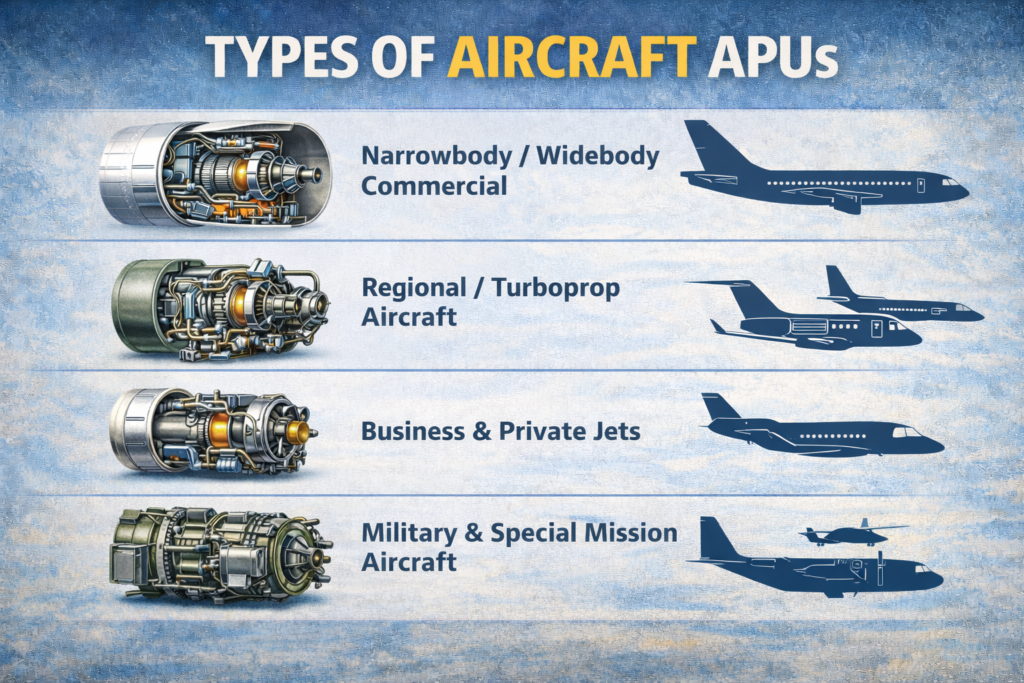
The Auxiliary Power Unit (APU) is often treated as a single system category, but in reality, APUs vary significantly depending on aircraft type, operational requirements, and design philosophy.
Understanding these differences is critical for operators, lessors, and maintenance teams. The type of APU installed on an aircraft directly affects fuel consumption, maintenance cycles, reliability, and sourcing strategy.
Selecting, maintaining, or replacing the right APU is not just a technical decision. It is an operational and financial one.
2. Gas Turbine APUs (Most Common)
Gas turbine APUs are the standard across most commercial and business aircraft.
These units function as small jet engines designed specifically to generate electrical power and compressed air.
Key Characteristics
- Fueled by aircraft jet fuel
- High power output relative to size
- Reliable across a wide range of environments
- Integrated into most commercial aircraft platforms
Where They Are Used
- Commercial airliners (narrowbody and widebody)
- Business jets
- Many military aircraft
Advantages
- Proven reliability
- High power-to-weight ratio
- Ability to provide both electrical and pneumatic output
Considerations
- Higher fuel consumption compared to alternatives
- Requires regular maintenance due to high cycle usage
- Sensitive to operating conditions and wear
Gas turbine APUs remain dominant because they provide the best balance of power, reliability, and compatibility with existing aircraft systems.
3. Electric APUs (Emerging Technology)
Electric APUs are a newer development, gaining traction as the aviation industry moves toward efficiency and reduced emissions.
Instead of using a fuel-burning turbine, these systems rely on batteries or hybrid-electric systems.
Key Characteristics
- No direct fuel combustion
- Lower emissions
- Reduced noise profile
- Dependent on onboard electrical storage systems
Where They Are Used
- New-generation aircraft concepts
- Experimental and hybrid platforms
- Select business aviation applications
Advantages
- Lower operating costs over time
- Reduced environmental impact
- Fewer moving parts (potentially lower maintenance)
Considerations
- Limited power output compared to turbine APUs
- Battery weight and storage constraints
- Not yet widely adopted across commercial fleets
While not yet standard, electric APUs represent a shift toward more sustainable aircraft systems and will likely expand as battery technology improves.
4. Hydraulic APUs (Specialized Applications)
Hydraulic APUs are less common but still used in certain aircraft configurations, particularly where hydraulic power is critical.
These systems are designed primarily to provide hydraulic pressure rather than electrical or pneumatic power.
Key Characteristics
- Focused on hydraulic output
- Often integrated into specialized aircraft systems
- May operate alongside other APU types
Where They Are Used
- Military aircraft
- Older aircraft designs
- Aircraft with high hydraulic system dependency
Advantages
- Direct support for hydraulic systems
- Useful in aircraft with limited electrical requirements
Considerations
- Limited versatility compared to turbine APUs
- Rare in modern commercial aviation
- Often supplemented by other systems
Hydraulic APUs are typically part of niche applications rather than mainstream commercial operations.
5. Air Turbine Starters vs APUs
While not APUs themselves, air turbine starters (ATS) are often confused with APU systems.
These systems use compressed air to start the main engines but do not generate independent power.
Key Differences
- ATS requires an external or onboard air source
- APUs generate both air and electrical power
- ATS cannot operate aircraft systems independently
Understanding this distinction is important when evaluating aircraft capabilities, especially in remote or infrastructure-limited environments.
6. APUs by Aircraft Size and Class
APU design and capability vary significantly based on the size and mission of the aircraft.
Large Commercial Aircraft APUs
- High output capacity
- Designed to support large passenger cabins
- Integrated with complex environmental systems
Narrowbody Aircraft APUs
- Moderate power output
- Optimized for efficiency and quick turnaround operations
Business Jet APUs
- Smaller, quieter units
- Focus on passenger comfort and noise reduction
Regional Aircraft APUs
- Compact and efficient
- Designed for frequent short-haul cycles
Each category reflects a balance between power requirements, weight constraints, and operational demands.
7. Military vs Commercial APUs
Military aircraft often use APUs differently than commercial aircraft.
Military APU Characteristics
- Designed for extreme environments
- Capable of operating in remote or combat conditions
- May integrate additional system redundancies
Commercial APU Characteristics
- Optimized for efficiency and reliability
- Focused on passenger comfort and operational consistency
- Integrated with airport infrastructure
Military APUs prioritize survivability and independence, while commercial APUs prioritize efficiency and lifecycle cost.
8. APU Manufacturers and Platform Differences
APUs are typically produced by specialized manufacturers, with each unit designed for specific aircraft platforms.
Key Factors That Vary
- Output capacity
- Fuel efficiency
- Maintenance intervals
- Compatibility with aircraft systems
Because APUs are platform-specific, sourcing and replacement require careful attention to:
- Part numbers
- Certification standards
- Documentation and traceability
This becomes especially important in leasing and redelivery scenarios.
9. Maintenance and Lifecycle Differences by Type
Different APU types come with different maintenance profiles.
Gas Turbine APUs
- High maintenance due to thermal stress
- Regular inspections required
- Well-established overhaul processes
Electric APUs
- Potential for lower maintenance
- Battery lifecycle becomes critical
- Emerging support infrastructure
Hydraulic Systems
- Dependent on fluid system integrity
- Less common but still maintenance-intensive
Understanding these differences helps operators plan:
- Maintenance schedules
- Spare part strategies
- Replacement timelines
10. Cost and Sourcing Considerations
APU costs vary widely depending on:
- Aircraft type
- APU model
- Condition (new, overhauled, or used)
Key Cost Drivers
- Availability of units
- Maintenance history
- Certification and documentation
- Market demand
Operators must decide between:
- Purchasing for long-term use
- Leasing for flexibility
- Repairing existing units
In many cases, having access to both purchasing and leasing options allows operators to adapt quickly to changing operational needs.
11. Operational Strategy: Choosing the Right APU Approach
The right APU strategy depends on:
- Fleet composition
- Utilization rates
- Maintenance capabilities
- Financial constraints
Operators with high utilization may prioritize ownership, while those with variable demand or limited capital may benefit from leasing options.
Having access to the right type of APU at the right time is often more important than ownership alone.
12. Conclusion
Aircraft APUs are not one-size-fits-all systems.
They vary by:
- Technology (turbine, electric, hydraulic)
- Aircraft size and mission
- Operational requirements
Understanding these differences allows operators to:
- Improve efficiency
- Reduce downtime
- Make better sourcing decisions
As aircraft technology evolves, APU systems will continue to change, but their role as a critical support system will remain constant.
Air Viper Support for APU Operations
For operators managing different aircraft types and APU configurations, access to the right unit is essential for maintaining operational continuity.
Air Viper supports operators and lessors with both APU sales and leasing options, providing flexibility across a wide range of aircraft platforms. Whether the need is immediate replacement, short-term coverage, or long-term ownership, access to certified, traceable units ensures operations continue without disruption.
Flexible leasing structures and sourcing support make it possible to adapt quickly to maintenance cycles, unexpected failures, or fleet changes. For operators balancing cost, uptime, and compliance, having both purchase and lease pathways available provides a practical advantage.