
Aircraft operations depend on a wide range of systems and components, but few are as critical—or as valuable—as aircraft engines, auxiliary power units (APUs), and landing gear assemblies. These components represent some of the most complex engineering systems installed on an aircraft and play essential roles in flight operations, ground operations, and structural integrity.
Because these components experience significant mechanical stress and require periodic maintenance, aircraft operators must regularly source replacement units or spare assemblies. Whether the need arises from scheduled maintenance, unexpected failures, fleet expansion, or lease transitions, sourcing major aircraft components requires careful technical evaluation, documentation verification, and logistics coordination.
For airlines, cargo carriers, charter operators, and maintenance organizations, navigating the market for these high-value components can be challenging. Many operators rely on experienced aviation suppliers to help locate available inventory, verify certification documentation, and coordinate delivery.
Companies such as Air Viper, LLC assist aircraft operators by sourcing engines, APUs, landing gear assemblies, and other major components through global aviation supply networks. By verifying documentation and coordinating logistics, aviation suppliers help ensure that operators receive certified components ready for installation.
This article explains how major aircraft components are sourced and what operators should understand when procuring engines, APUs, and landing gear systems.
Why Major Aircraft Component Sourcing Is Important
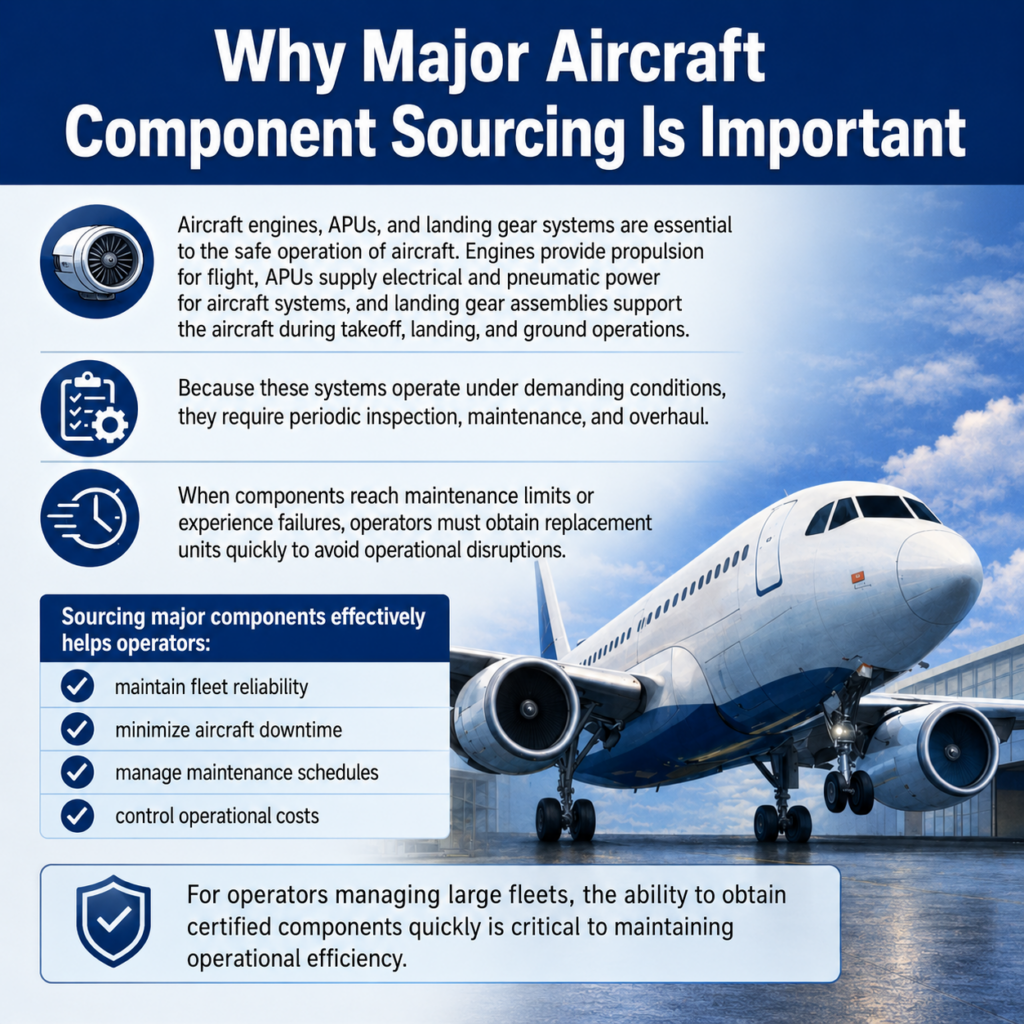
Aircraft engines, APUs, and landing gear systems are essential to the safe operation of aircraft. Engines provide propulsion for flight, APUs supply electrical and pneumatic power for aircraft systems, and landing gear assemblies support the aircraft during takeoff, landing, and ground operations.
Because these systems operate under demanding conditions, they require periodic inspection, maintenance, and overhaul.
When components reach maintenance limits or experience failures, operators must obtain replacement units quickly to avoid operational disruptions.
Sourcing major components effectively helps operators:
- maintain fleet reliability
- minimize aircraft downtime
- manage maintenance schedules
- control operational costs
For operators managing large fleets, the ability to obtain certified components quickly is critical to maintaining operational efficiency.
Sourcing Aircraft Engines
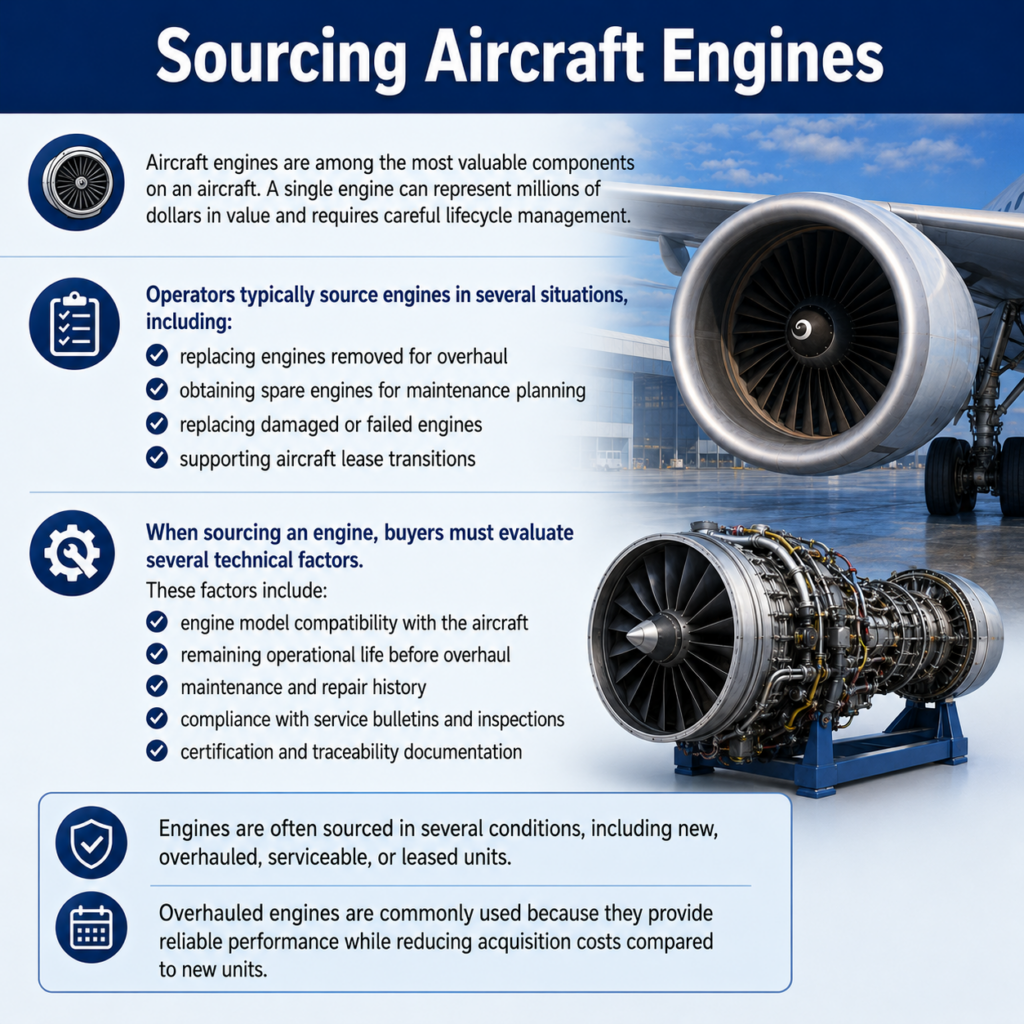
Aircraft engines are among the most valuable components on an aircraft. A single engine can represent millions of dollars in value and requires careful lifecycle management.
Operators typically source engines in several situations, including:
- replacing engines removed for overhaul
- obtaining spare engines for maintenance planning
- replacing damaged or failed engines
- supporting aircraft lease transitions
When sourcing an engine, buyers must evaluate several technical factors.
These factors include:
- engine model compatibility with the aircraft
- remaining operational life before overhaul
- maintenance and repair history
- compliance with service bulletins and inspections
- certification and traceability documentation
Engines are often sourced in several conditions, including new, overhauled, serviceable, or leased units.
Overhauled engines are commonly used because they provide reliable performance while reducing acquisition costs compared to new units.
Sourcing Aircraft APUs
Auxiliary Power Units are small turbine engines typically installed in the tail section of an aircraft. APUs provide electrical power and compressed air when the aircraft’s main engines are not operating.
They perform several important functions, including:
- starting the main engines
- powering onboard systems on the ground
- providing air conditioning during ground operations
- supporting maintenance activities
Because APUs operate frequently during ground operations, they experience wear and require periodic maintenance or replacement.
Operators may source APUs when:
- a unit fails unexpectedly
- scheduled overhaul events occur
- spare APUs are needed for maintenance planning
- aircraft configuration changes require replacement units
APUs are commonly sourced from manufacturers, maintenance repair organizations, aviation leasing companies, or surplus component inventories.
Buyers must verify compatibility with the aircraft model and ensure that proper documentation accompanies the unit.
Sourcing Landing Gear Assemblies
Landing gear systems support the aircraft during takeoff, landing, and taxi operations. These assemblies absorb impact forces during landing and must withstand repeated stress throughout the aircraft’s operational life.
Landing gear systems require periodic overhaul based on flight cycles or calendar time.
Operators typically source landing gear assemblies when:
- assemblies are removed for overhaul
- spare assemblies are needed to support maintenance planning
- structural issues are identified during inspections
- aircraft undergo lease transitions or sales
Landing gear assemblies are often sourced as overhauled units that have been restored to airworthy condition by certified repair facilities.
Because these assemblies are large and complex, sourcing them often involves coordination with maintenance providers and logistics specialists.
The Role of the Global Aviation Market
The market for engines, APUs, and landing gear operates on a global scale.
Components may be owned by airlines, leasing companies, maintenance providers, aircraft dismantling facilities, or aviation asset managers located in different parts of the world.
This global marketplace allows operators to access a wider range of available inventory and obtain components more quickly.
Major sources of component supply include:
- aircraft manufacturers
- maintenance repair organizations
- aviation leasing companies
- aircraft teardown operations
- aviation parts suppliers
Because engines, APUs, and landing gear systems can remain in service for many years with proper maintenance, the secondary market for these components is an important part of the aviation supply chain.
Documentation and Certification Requirements
Proper documentation is essential when sourcing major aircraft components.
Aviation regulations require that engines, APUs, and landing gear assemblies include documentation confirming their maintenance history and certification status.
Typical documentation associated with these components includes:
- authorized release certificates
- maintenance records
- repair and overhaul documentation
- component traceability records
- inspection reports
These records provide a complete history of the component and confirm that it meets airworthiness requirements.
Without proper documentation, a component may not be eligible for installation on an aircraft.
For this reason, buyers must carefully review documentation before completing a purchase.
Logistics and Transportation of Major Components
After a component has been sourced and documentation verified, logistics providers must coordinate transportation to the operator’s location.
Major aircraft components require specialized shipping procedures because of their size, weight, and value.
Logistics planning typically includes:
- protective transport containers
- specialized handling procedures
- air freight transportation for long-distance delivery
- ground transport to maintenance facilities
International shipments may also require customs documentation and export compliance procedures.
Proper logistics coordination ensures that components arrive safely and that documentation remains associated with the shipment.
Working With Aviation Suppliers
Sourcing engines, APUs, and landing gear assemblies requires coordination across multiple organizations within the aviation industry.
Aviation suppliers help simplify this process by managing component sourcing and logistics on behalf of operators.
Suppliers maintain industry relationships that allow them to locate available components quickly and verify documentation before shipment.
They may assist operators with:
- locating compatible components worldwide
- reviewing maintenance and certification records
- coordinating inspections
- arranging logistics and transportation
By working with experienced suppliers, aircraft operators can reduce procurement complexity and improve access to certified components.
Supporting Reliable Aircraft Operations
Sourcing major aircraft components is an essential part of maintaining reliable aircraft operations.
Engines, APUs, and landing gear assemblies require careful lifecycle management and periodic replacement to ensure that aircraft remain safe and operational.
Through the global aviation supply network, operators can access replacement components from manufacturers, maintenance providers, leasing companies, and aviation suppliers.
Companies such as Air Viper, LLC support aircraft operators by sourcing certified engines, APUs, and landing gear assemblies while ensuring that documentation and logistics requirements are handled correctly.
By combining global sourcing expertise with aviation documentation knowledge, suppliers help operators obtain the critical components needed to maintain safe, efficient, and reliable fleet operations.
Contact Air Viper, LLC
Air Viper, LLC provides independent aircraft technical representation, maintenance oversight, aircraft records support, and lease transition services for aircraft owners, operators, and leasing companies. We help ensure aircraft maintenance events, inspections, and technical projects are completed correctly while protecting the long-term value of the asset.
To discuss your aircraft project, contact our team:
Phone: +1 (918) -524-9380
Email: [email protected]
Air Viper, LLC’s Founder

Forrest Ludwig is a dynamic entrepreneur with a passion for aviation parts supply, customer service, and business innovation. With a keen eye for efficiency and precision, he has dedicated his career to connecting operators, MROs, and aviation professionals with the right parts at the right time—minimizing downtime and maximizing operational success.
A true believer in customer-first solutions, Forrest has built a reputation for delivering exceptional service, transparency, and reliability in the aviation industry. His expertise spans aviation parts sourcing, logistics, supply chain optimization, and aircraft sales & leasing, ensuring clients receive cost-effective and high-quality solutions tailored to their needs.
With a forward-thinking approach and a commitment to excellence, Forrest continues to revolutionize aviation parts supply by streamlining processes, enhancing customer experience, and creating innovative solutions for a rapidly evolving industry.
Passionate about aviation. Dedicated to service. Committed to keeping fleets in the air.
Learn More About The Rest Of Our Team!
Why Airlines, Lessors, and MROs Choose Air Viper, LLC
Air Viper, LLC provides aviation parts sourcing, aircraft inspection services, and aircraft transaction support for operators worldwide. Customers work with Air Viper, LLC because the company focuses on efficiency, reliability, and industry expertise. As an ASA-100 certified aviation distributor and a company registered with SAM.gov, Air Viper, LLC operates under recognized industry quality standards while maintaining the ability to support both commercial and government aviation customers.
1. Global Aircraft Parts Sourcing
Air Viper, LLC helps operators locate aircraft components through an international supplier network, including hard-to-find parts. By working with trusted manufacturers, distributors, and aviation suppliers worldwide, Air Viper can source components that may not be readily available through standard procurement channels.
2. Efficient Direct Shipping
Components can be shipped directly to customers using their preferred courier, reducing handling time and delivery delays. This streamlined shipping process helps operators receive critical parts faster and maintain operational continuity.
3. Access to Critical Aircraft Components
Air Viper, LLC assists with sourcing major components such as aircraft engines, auxiliary power units (APUs), and landing gear, along with other high-value aviation components. These components are essential to aircraft reliability and fleet performance.
4. Global Supplier Network
Through relationships with aviation suppliers worldwide, Air Viper, LLC helps customers access inventory across multiple markets. This global reach improves the likelihood of locating parts that may otherwise require extended lead times.
5. Aircraft and Engine Inspection Services
Air Viper, LLC provides on-site aircraft and engine inspection support for aircraft purchases, lease transitions, and technical evaluations. Independent inspection support helps operators make informed decisions during aircraft transactions.
6. Aircraft Sales and Leasing Support
Air Viper, LLC connects buyers, sellers, and lessors to help facilitate aircraft sales and leasing opportunities. By assisting with introductions, evaluations, and technical considerations, the company helps simplify complex aircraft transactions.
7. Aviation Logistics Coordination
Air Viper, LLC helps coordinate the logistics of aircraft components, simplifying the procurement and delivery process. Coordinated logistics reduce administrative complexity for operators managing multiple suppliers and shipments.
8. Aviation Industry Experience
With experience in aviation parts sourcing, logistics, and aircraft inspections, Air Viper, LLC understands the operational needs of airlines, leasing companies, and maintenance repair organizations (MROs). This experience allows the company to support customers with practical solutions tailored to aviation operations.
9. Quality Assurance and Regulatory Alignment
Air Viper, LLC is ASA-100 certified, a widely recognized aviation quality standard for distributors that emphasizes traceability, documentation control, and quality management practices. The company is also registered with SAM.gov, enabling it to work with U.S. government agencies and contractors that require vendor registration and compliance with federal procurement systems.
10. Faster Response for Time-Sensitive Needs
When aircraft operators need parts or inspection support quickly, Air Viper, LLC focuses on providing efficient responses and sourcing solutions. Aviation operations often require rapid decision-making and reliable supplier communication.
11. Supporting Aircraft Operations Worldwide
Air Viper, LLC works with aviation operators around the world to help support safe and efficient aircraft operations. By combining global sourcing capabilities, inspection services, and logistics coordination, the company helps customers keep aircraft flying and fleets operating at peak performance.