
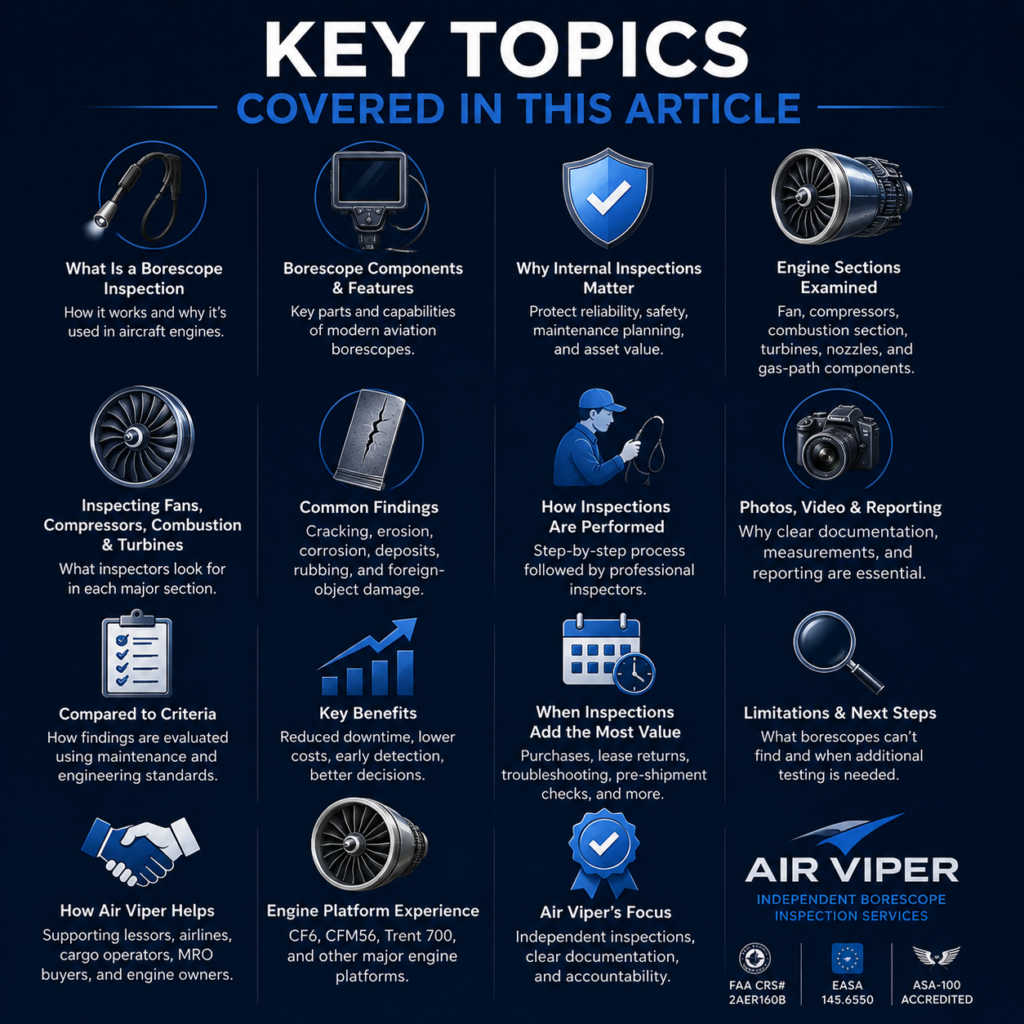
Key Topics Covered in This Article
- What aircraft engine borescope inspections are and how they work
- The main features of modern aviation borescopes
- Why internal engine inspections protect maintenance decisions and asset value
- Which engine sections can be examined, including fans, compressors, combustion areas, and turbines
- Common findings such as cracks, erosion, corrosion, deposits, rubbing, and foreign-object damage
- How professional inspections are performed and documented
- The importance of clear photos, video, measurements, and reporting
- How findings are compared with maintenance and engineering criteria
- Benefits such as reduced downtime, lower costs, and earlier problem detection
- When inspections are most useful, including purchases, lease returns, troubleshooting, and shipping
- The limits of visual inspections and when further testing is needed
- How Air Viper supports lessors, operators, MRO buyers, and engine owners
- Air Viper’s experience with CF6, CFM56, Trent 700, and other major platforms
- Air Viper’s focus on independent inspections, clear documentation, and accountability
Aircraft engines operate under extreme heat, pressure, vibration, and rotational force. Many of their most important components are located deep inside the engine, where they cannot be evaluated during a normal exterior inspection.
An engine may look clean and properly maintained from the outside while still containing internal cracking, erosion, corrosion, deposits, blade damage, rubbing, overheating, or foreign-object damage. These conditions can affect reliability, maintenance costs, asset value, lease compliance, and the safety of future operations.
An aircraft engine borescope inspection gives qualified inspectors a way to examine accessible internal areas without completely disassembling the engine.
For airlines, cargo operators, lessors, engine owners, buyers, sellers, and MRO organizations, a professional borescope inspection can provide valuable visual evidence before an engine is purchased, shipped, transferred, returned from lease, or installed.
Air Viper, LLC supports aviation stakeholders with independent borescope inspections focused on thorough examination, clear documentation, and accountability.
What Is an Aircraft Engine Borescope Inspection?
A borescope inspection is a form of remote visual inspection used to examine internal areas that cannot be viewed directly.
The inspector inserts a narrow probe through designated access ports in the engine. A camera and lighting system at the end of the probe transmit live images to a digital display, allowing the inspector to view accessible internal components.
The probe can often be articulated, meaning the tip can be moved in different directions. This allows the inspector to look around blades, vanes, liners, cases, seals, and other components from multiple angles.
The process is commonly called:
- A borescope inspection
- BSI
- Remote visual inspection
- Video borescope inspection
The primary advantage is that important engine areas can be examined without removing and disassembling every component.
This makes borescope inspections useful for routine maintenance, troubleshooting, transaction support, lease events, incident evaluation, pre-shipment checks, and engine-condition verification.
Components of a Modern Aviation Borescope
Modern aviation borescopes are much more advanced than simple optical viewing devices.
A professional system may include several important components.
Flexible Insertion Probe
The insertion probe is a long, narrow tube that enters the engine through an inspection port. It must be small enough to reach confined areas while remaining durable enough for repeated use.
The probe may contain internal wiring, fiber-optic lighting, camera components, and control mechanisms.
High-Resolution Camera
A camera at the end of the probe captures live images of internal engine surfaces.
Image quality is critical. The inspector must be able to distinguish between normal surface appearance and potentially significant findings such as cracking, coating loss, impact damage, or material deterioration.
Integrated Lighting
Internal engine areas are dark, so the borescope requires a reliable lighting system.
The inspector may adjust the brightness to reduce glare, improve contrast, and reveal surface details. Poor lighting can hide a finding or create misleading reflections.
Articulating Tip
An articulating tip allows the inspector to control the direction of the camera.
This is especially important when examining blade edges, airfoil surfaces, turbine nozzles, cooling features, combustion liners, and areas located behind other components.
Digital Display
The display shows the live camera image.
A larger, high-quality screen helps the inspector evaluate details, maintain proper orientation, and capture useful evidence.
Recording and Measurement Features
Many modern borescopes can capture:
- Still photographs
- Video recordings
- Measurements
- Annotations
- Voice notes
- Image labels
- Inspection folders
These features improve the quality and organization of the final inspection record.
Why Internal Engine Inspections Are Important
Aircraft engine interiors are exposed to operating conditions that can cause wear and damage over time.
These conditions include:
- High temperatures
- Rapid thermal cycling
- Extreme rotational speeds
- Pressure changes
- Vibration
- Foreign-object ingestion
- Moisture
- Salt exposure
- Oil and carbon deposits
- Mechanical contact
- Corrosion
Many internal findings cannot be identified through exterior inspection alone.
Maintenance records are important, but they only reflect what was previously inspected and documented. An engine’s condition may change after its last inspection.
A borescope inspection provides current visual evidence of accessible internal areas.
This can help stakeholders answer important questions:
- Does the engine’s internal condition match its records?
- Is there visible evidence of distress?
- Are the findings within acceptable limits?
- Is additional inspection required?
- Could the condition affect the asset’s value?
- Should maintenance be scheduled before the engine moves?
- Is the engine being represented accurately?
For high-value aviation assets, those questions can have major financial consequences.
Which Engine Sections Can Be Examined?
The exact scope depends on the engine platform, available inspection ports, technical instructions, and the purpose of the inspection.
A borescope inspection may include portions of the following sections.
Fan Section
The fan is the first major rotating assembly visible at the front of many turbofan engines.
Inspectors may examine fan blades and surrounding components for:
- Nicks
- Dents
- Cracks
- Erosion
- Leading-edge damage
- Tip damage
- Surface contamination
- Foreign-object impact
- Corrosion
Some fan conditions are visible externally, but a borescope may provide improved access to blade surfaces, roots, platforms, or areas that are difficult to view from the inlet.
Low-Pressure Compressor
The low-pressure compressor begins compressing incoming air before it reaches the higher-pressure stages.
Possible findings include:
- Blade erosion
- Bent airfoils
- Deposits
- Corrosion
- Rub marks
- Missing material
- Foreign-object damage
- Abnormal surface wear
The engine may need to be rotated so each accessible blade can be examined.
High-Pressure Compressor
The high-pressure compressor operates under demanding pressure, temperature, and rotational conditions.
Damage in this area can affect airflow, efficiency, engine stability, and performance.
An inspector may look for:
- Cracks
- Airfoil deformation
- Tip rubbing
- Leading-edge damage
- Trailing-edge damage
- Erosion
- Corrosion
- Deposits
- Impact marks
- Missing material
Because these stages are located deep inside the engine, remote visual access is especially valuable.
Combustion Section
The combustion section mixes compressed air with fuel and burns the mixture to generate high-energy gas.
This area is exposed to intense heat and repeated thermal cycling.
Common visible conditions may include:
- Cracking
- Burning
- Distortion
- Liner deterioration
- Cooling-hole damage
- Material loss
- Excessive deposits
- Abnormal discoloration
- Hot spots
- Fuel-pattern irregularities
Some discoloration may be expected during normal service. The inspector must document the condition accurately and compare it with the applicable criteria.
High-Pressure Turbine
The high-pressure turbine extracts energy from the combustion gases and drives the high-pressure compressor.
Its components operate in one of the most severe environments inside the engine.
Possible findings include:
- Oxidation
- Cracking
- Burning
- Coating loss
- Erosion
- Cooling-hole blockage
- Tip distress
- Trailing-edge deterioration
- Impact damage
- Missing material
High-pressure turbine findings can have substantial maintenance and financial consequences.
Low-Pressure Turbine
The low-pressure turbine helps drive the fan and low-pressure compressor.
Inspectors may examine accessible blades, vanes, shrouds, and cases for:
- Cracks
- Erosion
- Tip wear
- Rub marks
- Deposits
- Impact damage
- Coating deterioration
- Material loss
- Surface distress
The location and extent of a finding help determine whether additional review is necessary.
Common Findings During Borescope Inspections
A borescope is primarily a visual tool. It is designed to identify conditions visible on accessible surfaces.
Common findings may include the following.
Cracking
Cracks may appear in blades, vanes, liners, nozzles, cases, or other components.
Their importance depends on their location, length, direction, depth, and relationship to published limits.
Erosion
Erosion can gradually remove material from blade edges, coatings, and gas-path surfaces.
It may result from airflow, particles, environmental exposure, or long-term operation.
Corrosion
Corrosion may develop when engines are exposed to moisture, coastal air, salt, inadequate preservation, or long storage periods.
Visible corrosion may require further assessment to determine its severity.
Deposits and Contamination
Carbon, oil, dirt, salt, or other materials may accumulate inside the engine.
Deposits can affect cooling features, airflow, component visibility, and performance.
Rubbing and Contact
Visible rub marks may indicate contact between rotating and stationary components.
The inspector may observe polished surfaces, worn tips, circumferential marks, scraping, or material transfer.
Foreign-Object Damage
Debris entering the engine may strike blades and other components.
Foreign-object damage can include dents, nicks, tears, bent airfoils, impact marks, and missing material.
Even a small defect may require careful evaluation depending on its location.
How a Professional Borescope Inspection Is Performed
A professional inspection begins before the probe enters the engine.
The inspector reviews:
- The engine model
- Serial information
- Maintenance documentation
- The requested scope
- Known concerns
- Relevant inspection procedures
- Access-port locations
- Applicable limits
The engine must then be prepared safely. Access plugs or covers are removed according to the appropriate procedures.
The inspector inserts the probe carefully and examines the required sections. The engine may be rotated to inspect multiple blades or stages.
Throughout the inspection, the inspector must manage:
- Probe position
- Camera orientation
- Image focus
- Lighting
- Viewing angle
- Surface reflections
- Component identification
- Image stability
When a finding is observed, the inspector captures photographs or video and documents its location.
A strong report should identify:
- The engine inspected
- The date and location
- The inspection scope
- The sections examined
- The component or stage
- The location of each finding
- The visible condition
- Any measurements
- Any inaccessible areas
- Recommended follow-up
Why Photos, Video, and Reporting Matter
The inspection itself is only part of the process.
The findings must also be documented clearly enough for other stakeholders to understand and evaluate them.
Poor documentation can create uncertainty. A blurry image, unlabeled photograph, or vague note such as “damage observed” may not be useful during a lease discussion, engine sale, insurance review, or engineering evaluation.
Clear photographs and video help establish what was visible at the time of inspection.
Good reporting supports:
- Maintenance planning
- Purchase decisions
- Lease negotiations
- Repair estimates
- Engineering review
- Insurance evaluations
- Dispute resolution
- Asset-condition records
Air Viper emphasizes clear documentation because an inspection should provide evidence that can be reviewed and defended, not simply a verbal opinion.
Comparing Findings With Maintenance Criteria
Not every visible imperfection makes an engine unserviceable.
Many engine components have allowable limits for wear, erosion, cracking, dents, coating loss, deposits, and other conditions.
Findings must be compared with the applicable:
- Engine maintenance manual
- Inspection manual
- Repair criteria
- Engineering instructions
- Manufacturer guidance
- Airworthiness requirements
- Lease-return conditions
The inspector documents what is visible. Some findings may require further review by engineering personnel, the engine manufacturer, or another authorized technical authority.
Accurate location and measurement are important because the acceptability of a finding often depends on specific dimensions and component areas.
Benefits of Aircraft Engine Borescope Inspections
Borescope inspections offer several important advantages.
Reduced Downtime
An on-wing or in-place inspection may be completed much faster than removing and disassembling the engine.
Lower Inspection Costs
Complete disassembly requires labor, tooling, transportation, facilities, and additional maintenance resources.
A borescope inspection provides a less invasive first step.
Early Detection
Visible distress may be identified before it develops into a larger problem.
This can support planned maintenance rather than emergency action.
Better Asset Decisions
Buyers, lessors, operators, and MRO organizations gain more information before accepting financial or operational responsibility.
Stronger Documentation
Photos, video, measurements, and written findings create a condition record that can be reviewed later.
When Are Borescope Inspections Most Valuable?
Borescope inspections may be especially useful during:
- Engine purchases
- Engine sales
- Lease deliveries
- Lease returns
- Troubleshooting
- Foreign-object ingestion evaluations
- Bird-strike assessments
- Overtemperature events
- Compressor stalls or surges
- Abnormal vibration investigations
- MRO induction planning
- Pre-shipment checks
- Condition verification before installation
- Insurance reviews
- Asset repossessions
Before an engine moves, a borescope inspection can help document its condition and clarify responsibility.
Limitations of Remote Visual Inspection
A borescope inspection cannot reveal every possible defect.
It is limited to areas that are accessible and visible. Some components may be hidden by engine geometry. Subsurface cracks or internal material changes may not be visible.
The inspection may also be affected by:
- Limited access
- Deposits
- Oil contamination
- Poor viewing angles
- Lighting conditions
- Camera resolution
- Component geometry
Additional testing may be necessary.
Possible follow-up methods include:
- Eddy-current inspection
- Fluorescent penetrant testing
- Ultrasonic inspection
- Radiographic testing
- Dimensional measurement
- Oil or debris analysis
- Engineering review
- Partial disassembly
- Complete engine disassembly
A borescope inspection is a powerful condition-assessment tool, but it should not be presented as a guarantee that every possible defect has been identified.
How Air Viper Helps Aviation Stakeholders
Air Viper provides independent aircraft engine borescope inspections for lessors, airlines, cargo operators, MRO buyers, engine owners, and other aviation stakeholders.
Air Viper can support inspections before an engine is:
- Purchased
- Sold
- Shipped
- Transferred
- Returned from lease
- Installed
- Sent to an MRO
- Accepted by a new party
The company’s inspection approach focuses on:
- Independent and impartial evaluation
- Thorough examination of accessible areas
- Clear photographs
- Video documentation
- Organized reporting
- Accurate records
- Accountability
Air Viper supports inspections involving CF6, CFM56, Trent 700, and other major engine platforms.
With FAA Certified Repair Station No. 2AER160B, EASA.145.6550, ASA-100 accreditation, and more than 30 years of aviation maintenance experience, Air Viper brings technical knowledge and transaction-focused support to the inspection process.
Clearer Evidence for Better Aviation Decisions
Aircraft engine borescope inspections help aviation companies see what an exterior inspection cannot.
By examining accessible fan, compressor, combustion, turbine, nozzle, blade, seal, and gas-path areas, qualified inspectors can document visible signs of wear, damage, corrosion, overheating, deposits, and foreign-object impact.
The resulting evidence can support maintenance decisions, engine transactions, lease events, troubleshooting, repair planning, and pre-shipment verification.
Air Viper helps clients obtain this information through independent inspections, clear documentation, and accountable reporting.
For high-value aviation assets, the objective is not simply to look inside the engine. It is to produce reliable evidence that allows buyers, sellers, lessors, operators, and maintenance organizations to make more confident decisions.