
Aircraft maintenance is one of the most complex operational activities in the aviation industry. Every maintenance event requires coordination between airlines, aircraft owners, maintenance providers, engineers, regulators, and technical personnel. Because aircraft are highly regulated assets with strict safety and documentation requirements, proper oversight of maintenance activities is essential.
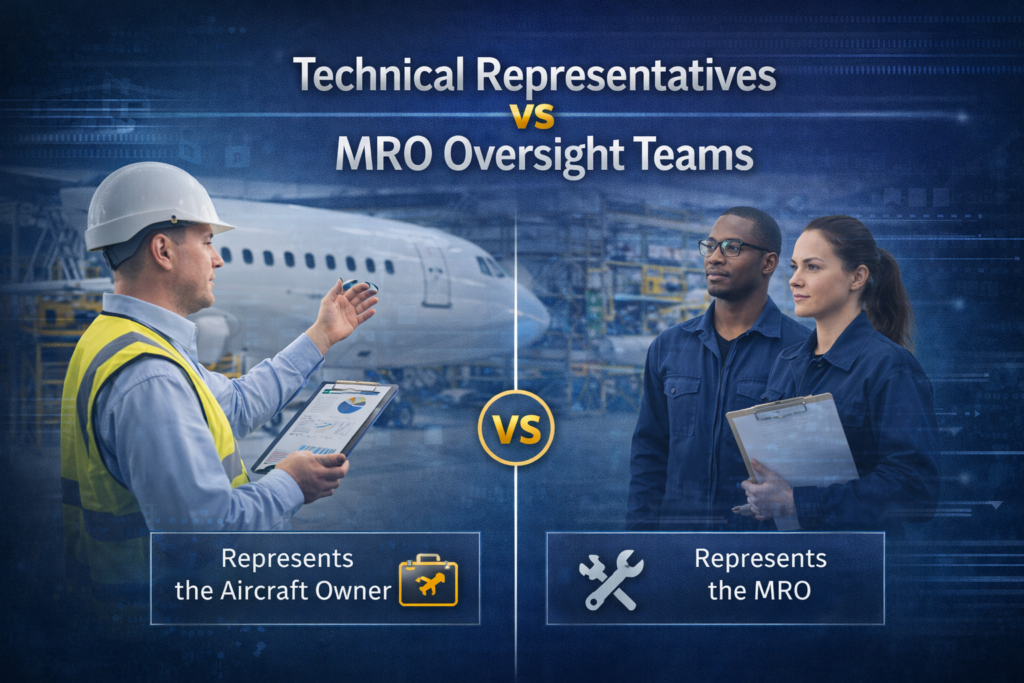
Two roles that often appear during aircraft maintenance events are technical representatives and MRO oversight teams. While both are involved in monitoring maintenance activities, they serve very different functions within the aviation ecosystem.
Understanding the difference between these roles is important for aircraft owners, airlines, and leasing companies seeking to maintain control over maintenance quality, regulatory compliance, and asset protection. Independent providers such as Air Viper, LLC often supply technical representation services that work alongside maintenance providers and their internal oversight teams.
Understanding Aircraft Maintenance Oversight
Aircraft maintenance typically takes place at specialized Maintenance, Repair, and Overhaul (MRO) facilities. These organizations perform inspections, repairs, modifications, and system maintenance for airlines and aircraft owners.
Because maintenance work involves critical safety systems and structural components, strict oversight is required to ensure that work is performed according to approved procedures and regulatory requirements.
Oversight within aircraft maintenance generally comes from two different sources:
- Internal oversight from the MRO organization itself
- External oversight from independent technical representatives
While both types of oversight contribute to safe maintenance operations, their responsibilities and objectives differ significantly.
What Is an MRO Oversight Team?
An MRO oversight team refers to the internal quality assurance and technical management personnel employed by the maintenance provider itself.
These teams are responsible for ensuring that the maintenance organization complies with aviation regulations and internal quality control procedures.
MRO oversight teams typically include professionals such as:
- quality assurance inspectors
- maintenance supervisors
- engineering staff
- compliance managers
- regulatory auditors
Their role is to ensure that maintenance work performed by technicians meets the standards required by aviation authorities such as the Federal Aviation Administration (FAA) and other regulatory agencies.
Responsibilities of MRO Oversight Teams
MRO oversight teams operate within the maintenance organization and are responsible for supervising the maintenance process from an operational and regulatory perspective.
Their responsibilities typically include:
Quality Control Inspections
Quality inspectors review maintenance tasks performed by technicians to ensure that work complies with approved procedures and maintenance manuals.
These inspections help confirm that tasks are completed properly before the aircraft is returned to service.
Regulatory Compliance Monitoring
MRO oversight teams ensure that maintenance operations comply with aviation regulations, including:
- FAA regulations
- repair station approvals
- regulatory certification requirements
- maintenance documentation standards
Maintaining regulatory compliance is critical for the MRO organization to retain its certification to perform aircraft maintenance.
Engineering Support
Engineering teams within the MRO provide technical instructions for repairs and modifications.
They develop engineering orders, evaluate maintenance findings, and coordinate with aircraft manufacturers when technical guidance is required.
Workscope Management
MRO oversight teams manage the overall maintenance workscope and ensure that maintenance tasks are scheduled and completed according to the project plan.
This includes coordinating technician teams, allocating resources, and maintaining maintenance timelines.
What Is an Aircraft Technical Representative?
An aircraft technical representative is an independent aviation professional who oversees maintenance activities on behalf of a stakeholder such as:
- an aircraft owner
- a leasing company
- an airline operator
- a financial investor
Unlike MRO oversight personnel, technical representatives do not work for the maintenance provider performing the work.
Instead, they represent the interests of the aircraft owner or operator and monitor maintenance activities independently.
Organizations such as Air Viper, LLC provide technical representation services by placing experienced aviation professionals on-site during maintenance events.
Responsibilities of Technical Representatives
Technical representatives serve as the owner’s or operator’s technical authority during maintenance events.
Their responsibilities focus on protecting the interests of the stakeholder they represent rather than managing the maintenance organization itself.
Independent Maintenance Oversight
Technical representatives monitor maintenance activities to verify that the work being performed meets contractual and technical requirements.
They observe inspections, repairs, and modifications to ensure that maintenance providers follow approved procedures.
Because they operate independently from the MRO, technical representatives can provide unbiased evaluations of maintenance quality.
Asset Protection
Aircraft represent major financial investments. Leasing companies and owners depend on maintaining aircraft condition and documentation quality in order to preserve asset value.
Technical representatives help protect these assets by ensuring that maintenance work is properly performed and documented.
They verify that repairs are carried out correctly and that the aircraft remains in compliance with lease conditions or owner requirements.
Documentation Review
Maintenance documentation plays a crucial role in demonstrating regulatory compliance and supporting aircraft transactions.
Technical representatives review records such as:
- maintenance log entries
- airworthiness directive compliance
- service bulletin incorporation
- modification records
- component traceability documentation
This review ensures that documentation accurately reflects the maintenance work performed on the aircraft.
Communication With Stakeholders
Technical representatives provide regular updates to aircraft owners, leasing companies, and operators regarding the progress of maintenance events.
These updates may include:
- maintenance progress reports
- inspection findings
- repair recommendations
- potential delays or cost impacts
This communication helps stakeholders maintain visibility into maintenance projects that may take place thousands of miles away from their offices.
Key Differences Between Technical Representatives and MRO Oversight Teams
Although both roles contribute to the oversight of aircraft maintenance, they differ in several fundamental ways.
Employer and Representation
The most important distinction between these roles is who they represent.
MRO oversight teams work for the maintenance provider performing the work. Their responsibility is to ensure that the MRO organization operates safely, efficiently, and in compliance with regulatory standards.
Technical representatives work on behalf of external stakeholders such as aircraft owners, airlines, or leasing companies.
Their responsibility is to ensure that the maintenance provider performs work that protects the interests of the stakeholder they represent.
Operational vs Independent Oversight
MRO oversight teams provide internal operational oversight. They supervise technicians, manage maintenance tasks, and maintain quality control within the organization.
Technical representatives provide independent oversight. They observe maintenance activities but do not manage technicians or direct the maintenance provider’s workforce.
This independence allows them to evaluate maintenance work from the perspective of the aircraft owner or operator.
Focus of Oversight
MRO oversight teams focus primarily on ensuring regulatory compliance and maintaining the operational integrity of the maintenance facility.
Technical representatives focus on ensuring that the aircraft itself meets contractual and technical requirements related to the stakeholder’s interests.
For example, a leasing company may require certain inspections or documentation standards as part of a lease agreement. A technical representative ensures that these requirements are satisfied during maintenance events.
Decision-Making Authority
MRO oversight teams typically have direct authority over maintenance operations within the repair station.
They can assign tasks, direct technicians, and manage maintenance schedules.
Technical representatives usually do not have direct operational authority within the MRO. Instead, they monitor activities and raise concerns or recommendations to the stakeholder they represent.
Their influence comes from communication and coordination rather than direct management of maintenance personnel.
Why Both Roles Are Necessary
Aircraft maintenance requires multiple layers of oversight to ensure safety, regulatory compliance, and asset protection.
MRO oversight teams ensure that maintenance providers follow regulatory procedures and maintain operational quality.
Technical representatives ensure that the interests of aircraft owners and operators are protected during maintenance events.
These roles complement each other rather than compete.
When both forms of oversight are present, maintenance activities benefit from:
- operational quality control from the MRO
- independent verification from technical representatives
This layered approach helps reduce risk and improve transparency in aircraft maintenance operations.
Technical Representation During Major Maintenance Events
Technical representatives are particularly valuable during complex maintenance events such as heavy maintenance checks and lease transitions.
During these events, aircraft may be disassembled for structural inspections, system evaluations, and component replacements.
Unexpected findings often occur during these inspections, requiring engineering evaluations and repair planning.
Technical representatives monitor these activities to ensure that repairs are performed correctly and properly documented.
They also communicate technical findings to aircraft owners so that decisions can be made quickly when additional maintenance work is required.
Supporting Aircraft Lease Transitions
Aircraft lease transitions are one of the most common situations where technical representatives work alongside MRO oversight teams.
When an aircraft is returned to its owner at the end of a lease, it must meet detailed technical return conditions.
Technical representatives monitor maintenance work performed to meet these requirements.
They verify that the aircraft meets conditions related to:
- maintenance status
- component life limits
- configuration standards
- documentation completeness
By overseeing these activities, technical representatives help ensure that lease returns proceed smoothly and that aircraft owners receive aircraft in the required technical condition.
The Role of Independent Technical Service Providers
Many aircraft owners and leasing companies rely on specialized technical service providers to supply experienced technical representatives.
These professionals typically have extensive backgrounds in aircraft maintenance, engineering, regulatory compliance, and fleet management.
Companies such as Air Viper, LLC provide independent technical representation services that support aircraft stakeholders during maintenance events, lease transitions, inspections, and return-to-service programs.
By placing experienced professionals on-site at maintenance facilities, these services provide stakeholders with real-time oversight of aircraft maintenance activities.
Improving Transparency in Aircraft Maintenance
Aircraft maintenance projects involve multiple organizations and large volumes of technical documentation.
Without proper oversight, it can be difficult for aircraft owners and operators to maintain visibility into maintenance activities.
Technical representatives improve transparency by providing independent monitoring and reporting throughout the maintenance process.
This transparency helps ensure that maintenance activities remain aligned with contractual obligations and asset management objectives.
Conclusion
Aircraft technical representatives and MRO oversight teams both play important roles in ensuring safe and compliant aircraft maintenance operations.
MRO oversight teams operate within maintenance organizations and focus on regulatory compliance, operational management, and quality control.
Technical representatives operate independently on behalf of aircraft owners, leasing companies, and operators. Their role is to monitor maintenance activities, verify documentation, and protect the interests of the stakeholder they represent.
Together, these two layers of oversight help create a comprehensive maintenance management system that supports safe aircraft operations and protects valuable aviation assets.
Independent technical service providers such as Air Viper, LLC help aircraft stakeholders maintain visibility and control during complex maintenance events by supplying experienced technical representatives who work alongside MRO organizations to ensure maintenance activities meet the required standards.
Contact Air Viper, LLC
Air Viper, LLC provides independent aircraft technical representation, maintenance oversight, aircraft records support, and lease transition services for aircraft owners, operators, and leasing companies. We help ensure aircraft maintenance events, inspections, and technical projects are completed correctly while protecting the long-term value of the asset.
To discuss your aircraft project, contact our team:
Phone: +1 (918) -524-9380
Email: [email protected]
Air Viper, LLC’s Founder

Forrest Ludwig is a dynamic entrepreneur with a passion for aviation parts supply, customer service, and business innovation. With a keen eye for efficiency and precision, he has dedicated his career to connecting operators, MROs, and aviation professionals with the right parts at the right time—minimizing downtime and maximizing operational success.
A true believer in customer-first solutions, Forrest has built a reputation for delivering exceptional service, transparency, and reliability in the aviation industry. His expertise spans aviation parts sourcing, logistics, supply chain optimization, and aircraft sales & leasing, ensuring clients receive cost-effective and high-quality solutions tailored to their needs.
With a forward-thinking approach and a commitment to excellence, Forrest continues to revolutionize aviation parts supply by streamlining processes, enhancing customer experience, and creating innovative solutions for a rapidly evolving industry.
Passionate about aviation. Dedicated to service. Committed to keeping fleets in the air.
Learn More About The Rest Of Our Team!
Why Airlines, Lessors, and MROs Choose Air Viper, LLC
Air Viper, LLC provides aviation parts sourcing, aircraft inspection services, and aircraft transaction support for operators worldwide. Customers work with Air Viper, LLC because the company focuses on efficiency, reliability, and industry expertise.
1. Global Aircraft Parts Sourcing
Air Viper, LLC helps operators locate aircraft components through an international supplier network, including hard-to-find parts.
2. Efficient Direct Shipping
Components can be shipped directly to customers using their preferred courier, reducing handling time and delivery delays.
3. Access to Critical Aircraft Components
Air Viper, LLC assists with sourcing major components such as aircraft engines, auxiliary power units (APUs), and landing gear.
4. Global Supplier Network
Through relationships with aviation suppliers worldwide, Air Viper, LLC helps customers access inventory across multiple markets.
5. Aircraft and Engine Inspection Services
Air Viper, LLC provides on-site aircraft and engine inspection support for aircraft purchases, lease transitions, and technical evaluations.
6. Aircraft Sales and Leasing Support
Air Viper, LLC connects buyers, sellers, and lessors to help facilitate aircraft sales and leasing opportunities.
7. Aviation Logistics Coordination
Air Viper, LLC helps coordinate the logistics of aircraft components, simplifying the procurement and delivery process.
8. Aviation Industry Experience
With experience in aviation parts sourcing, logistics, and aircraft inspections, Air Viper, LLC understands the operational needs of airlines, lessors, and maintenance organizations.
9. Faster Response for Time-Sensitive Needs
When aircraft operators need parts or inspection support quickly, Air Viper, LLC focuses on providing efficient responses and sourcing solutions.
10. Supporting Aircraft Operations Worldwide
Air Viper, LLC works with aviation operators around the world to help support safe and efficient aircraft operations.