
Key Topics Covered in This Article
- Common signs of APU failure or degradation
- How to distinguish repair vs replacement scenarios
- Operational and cost risks of delaying replacement
- Maintenance and compliance considerations
- When to involve certified aviation professionals
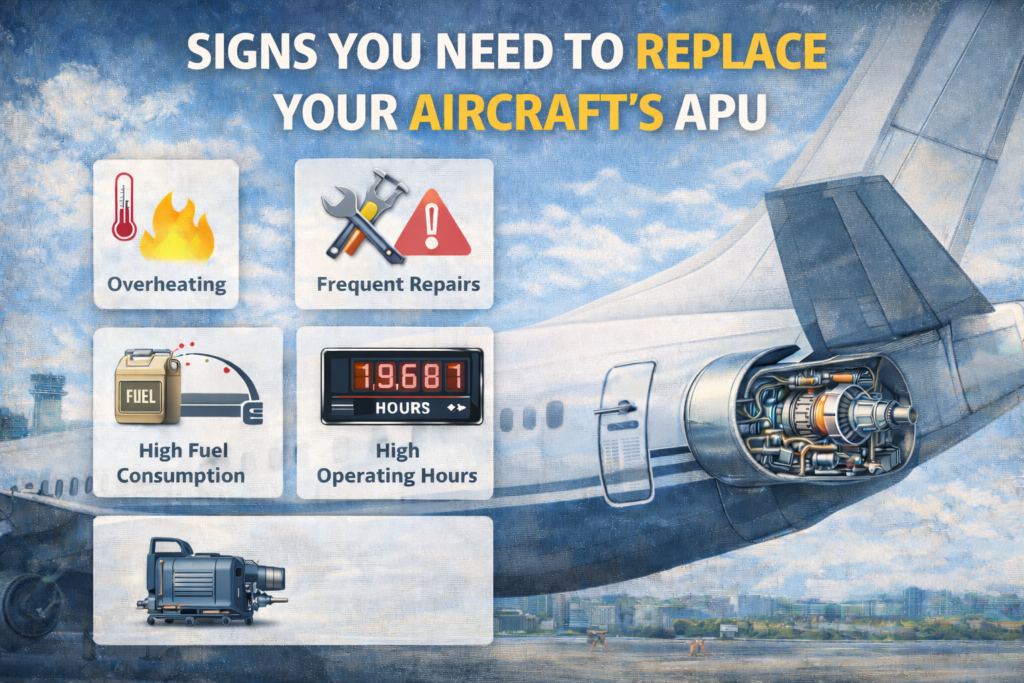
The Auxiliary Power Unit (APU) is one of the most heavily used systems on an aircraft.
Unlike main engines, which primarily operate during flight, APUs are used on nearly every ground cycle. They start frequently, operate under varying loads, and are exposed to continuous thermal stress.
Because of this, APUs rarely fail suddenly.
They degrade over time.
Recognizing early warning signs allows operators to:
- Avoid AOG events
- Reduce unplanned downtime
- Control maintenance costs
- Make proactive replacement decisions
Waiting too long to replace a failing APU often results in higher total costs, operational disruption, and compliance complications.
Important Disclaimer
The information provided in this article is for general informational and operational awareness purposes only. It is not intended to serve as a maintenance determination, airworthiness decision, or replacement directive.
All evaluations regarding the condition, repair, overhaul, or replacement of an aircraft APU must be performed and verified in person by appropriately qualified and certified aviation professionals. This includes, but is not limited to:
- FAA-certified Airframe and Powerplant (A&P) mechanics
- FAA Part 145 Repair Stations
- EASA Part-66 licensed engineers or equivalent international certifications
- Authorized maintenance organizations approved under applicable regulatory authorities
Final decisions should be based on direct inspection, approved maintenance data, manufacturer guidance, and regulatory requirements.
Increasing APU Start Failures
What This Looks Like
- Multiple start attempts required
- Slow or inconsistent spool-up
- Failed ignition sequences
What It Indicates
- Starter motor wear
- Fuel system irregularities
- Internal component degradation
Repeated start issues typically indicate broader system wear. As reliability declines, the likelihood of unplanned failure increases, making replacement more predictable than continued repair.
Rising Exhaust Gas Temperature (EGT)
Warning Signs
- Gradual increase in baseline EGT
- Frequent exceedances during operation
- Reduced margin to operating limits
Why It Matters
- Indicates turbine wear and reduced efficiency
- Increases thermal stress on components
- Raises risk of shutdowns and accelerated damage
Shrinking EGT margins are a strong indicator that the APU is approaching performance limits.
Oil Consumption and Leakage Issues
Common Symptoms
- Increased oil consumption between service intervals
- Visible oil leaks
- Contaminated oil samples
What This Suggests
- Seal degradation
- Bearing wear
- Internal component damage
Oil system issues often escalate quickly and are commonly associated with end-of-life conditions.
Decreasing Power Output
Warning Signs
- Inability to maintain electrical load
- Weak or inconsistent bleed air
- Reduced system performance
Operational Impact
- Affects engine start reliability
- Impacts cabin conditioning
- Limits ground operations
When the APU cannot meet system demands, it becomes an operational constraint.
Frequent Unscheduled Maintenance
Indicators
- Repeated unscheduled repairs
- Short intervals between maintenance events
- Increasing maintenance costs
What This Means
- Reliability is declining
- Downtime is increasing
- Costs are becoming unpredictable
At a certain point, continued repair becomes less efficient than replacement.
Excessive Noise or Vibration
What to Watch For
- Unusual noises during startup or operation
- Increased vibration levels
- Changes in normal operating characteristics
Possible Causes
- Imbalance in rotating components
- Internal damage
- Structural wear
These symptoms often precede more serious failures and should not be ignored.
Operational Disruptions and AOG Events
Examples
- AOG events caused by APU failure
- Delays due to lack of onboard power
- Increased reliance on GPUs
Why This Matters
- Reliability is compromised
- Operational costs increase
- Scheduling becomes unpredictable
At this stage, the APU is no longer supporting operations effectively.
Compliance and Documentation Gaps
Common Issues
- Incomplete maintenance records
- Missing traceability documentation
- Non-compliance with standards such as ASA-100
Impact
- Delayed lease returns
- Reduced asset value
- Regulatory exposure
Even a functioning APU may require replacement if documentation does not meet requirements.
Repair vs Replacement Decision Point
Consider Replacement When
- Failures are becoming frequent
- Costs are increasing unpredictably
- Reliability impacts operations
- Compliance risks are present
Consider Repair When
- Issues are isolated
- Costs are predictable
- Reliability remains stable
Evaluating total lifecycle cost is critical when making this decision.
Conclusion
APUs rarely fail without warning.
The signs typically appear through:
- Performance degradation
- Maintenance patterns
- Operational impact
Recognizing these signals early allows operators to:
- Plan replacements proactively
- Reduce downtime
- Maintain operational consistency
Treating the APU as a managed asset rather than a reactive component leads to stronger operational outcomes.
Air Viper Support for APU Operations
When APU performance begins to decline or replacement becomes necessary, having access to the right solution quickly is critical.
Air Viper supports operators and lessors with both APU sales and leasing options, providing flexibility based on operational and financial needs. Whether the requirement is immediate replacement, temporary coverage, or long-term ownership, access to certified, traceable units helps maintain continuity.
Flexible leasing options allow operators to bridge gaps during maintenance or unexpected failures, while purchasing options provide stability for long-term fleet planning.
In environments where uptime, compliance, and speed all matter, having access to both pathways simplifies decision-making and keeps operations moving.