
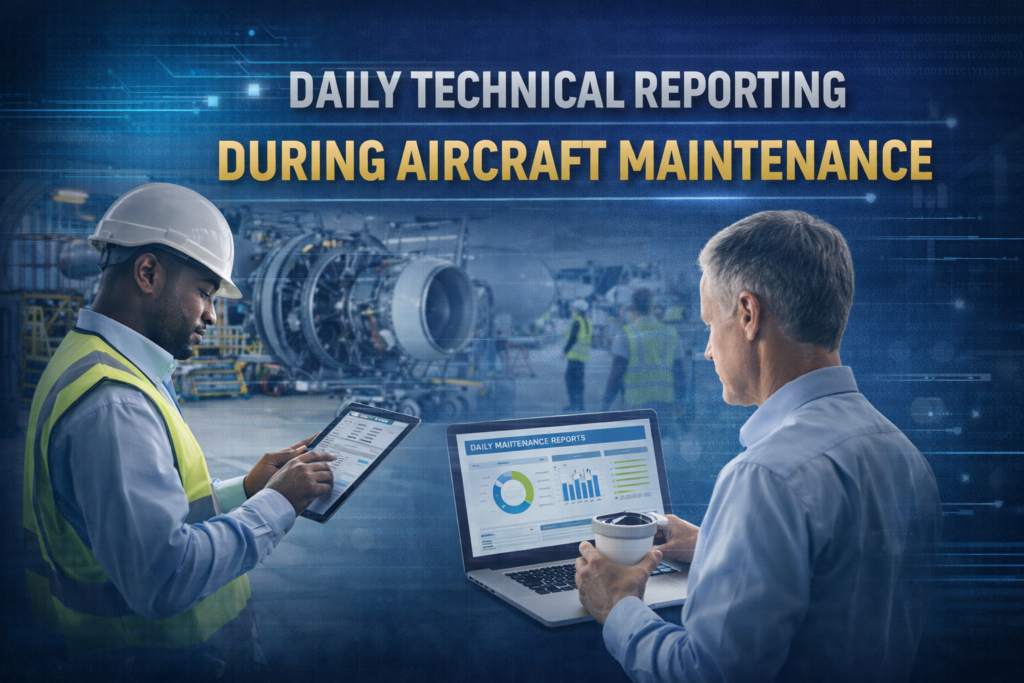
Aircraft maintenance projects—particularly heavy checks such as C-checks, structural inspections, and major modifications—are complex undertakings that involve hundreds of individual tasks, multiple engineering teams, strict regulatory oversight, and tight operational timelines. For aircraft owners, leasing companies, and airlines, maintaining clear visibility into maintenance progress is essential. This is where daily technical reporting becomes a critical component of aircraft maintenance oversight.
Daily technical reporting provides aircraft owners and asset managers with structured updates on maintenance progress, technical findings, emerging issues, and schedule impacts. These reports allow stakeholders to monitor work being performed by maintenance organizations (MROs), ensure compliance with regulatory requirements, and protect the long-term value of the aircraft asset.
Independent technical representatives—such as those provided by Air Viper LLC—often play a central role in producing and distributing these daily reports during major maintenance events.
What Is Daily Technical Reporting in Aircraft Maintenance?
Daily technical reporting refers to the structured documentation and communication of maintenance progress, technical findings, and operational updates generated each day during an aircraft maintenance event.
These reports are typically prepared by on-site technical representatives or project managers overseeing the maintenance check. The goal is to ensure that aircraft owners, lessors, and operators receive accurate, timely updates about the aircraft’s condition and maintenance progress.
Daily reports typically summarize:
- Maintenance tasks completed during the day
- Work packages currently in progress
- Findings discovered during inspections
- Schedule status and projected completion dates
- Parts and materials issues
- Engineering approvals or technical questions
- Any deviations from the planned maintenance scope
Because maintenance checks can last several weeks—or even months—daily reporting ensures that stakeholders remain informed and can make decisions quickly when issues arise.
Why Daily Technical Reporting Is Critical
Aircraft maintenance events involve substantial financial and operational stakes. Without proper reporting, aircraft owners may have limited visibility into work being performed on their asset.
Daily reporting serves several important purposes.
Maintaining Oversight of Third-Party Maintenance
Many aircraft maintenance events are performed by third-party MRO facilities rather than the aircraft operator itself. While these organizations operate under strict regulatory frameworks, aircraft owners still require independent oversight to verify that maintenance is being performed according to approved procedures.
Daily technical reports allow stakeholders to track:
- Whether maintenance tasks are being completed as planned
- Whether any deviations or delays are occurring
- Whether work is being carried out in accordance with approved maintenance programs
This transparency is particularly important when multiple vendors, contractors, or engineering teams are involved.
Identifying Technical Issues Early
Aircraft inspections frequently reveal unexpected findings, such as:
- Corrosion
- Structural damage
- Component wear
- Wiring degradation
- Fluid leaks
Daily reporting ensures that these discoveries are communicated immediately to aircraft owners and engineering teams. Early identification allows stakeholders to assess repair options, approve engineering solutions, and manage costs before the issues escalate.
Protecting Maintenance Schedules
Aircraft downtime can be extremely costly. Airlines rely on aircraft availability to maintain operational schedules, and leasing companies often have contractual obligations tied to aircraft availability.
Daily technical reports help project managers monitor schedule performance by documenting:
- Work completed versus planned tasks
- Delays caused by technical findings
- Parts shortages or supply chain issues
- Engineering approval timelines
This information allows stakeholders to take corrective action if the project begins to fall behind schedule.
Managing Maintenance Costs
Unexpected technical findings can significantly increase maintenance costs. Daily reporting provides early visibility into potential cost drivers so that aircraft owners can review repair options and control spending.
Who Produces Daily Technical Reports?
Daily technical reports are typically prepared by technical representatives or maintenance oversight specialists working on behalf of aircraft owners, lessors, or operators.
These professionals are responsible for monitoring maintenance progress and communicating updates to stakeholders.
Technical representatives may include:
- Aircraft engineers assigned by the operator
- Independent maintenance oversight consultants
- Asset management representatives from leasing companies
- Third-party technical service providers such as Air Viper LLC
Independent technical representatives provide an objective perspective because they work directly for the aircraft owner or asset manager rather than the maintenance organization performing the work.
Information Included in Daily Maintenance Reports
A well-structured daily technical report contains several key sections that provide a comprehensive overview of maintenance activity.
Aircraft Identification and Maintenance Event Details
Each report typically begins with basic information identifying the aircraft and maintenance event.
This section may include:
- Aircraft registration number
- Aircraft serial number
- Aircraft type and model
- Maintenance facility location
- Type of maintenance check being performed
- Project start date and planned completion date
These details ensure that all stakeholders are referencing the correct aircraft and maintenance program.
Maintenance Progress Summary
The progress summary provides a high-level overview of the work completed during the reporting period.
This section typically includes:
- Major tasks completed during the day
- Inspection areas opened or closed
- Structural areas inspected
- Components removed or installed
The progress summary allows stakeholders to quickly understand how the maintenance check is progressing relative to the planned schedule.
Inspection Findings
One of the most important sections of a daily technical report is the documentation of inspection findings.
Maintenance inspections often reveal issues that require additional corrective action. These findings may include:
- Corrosion discovered during structural inspections
- Cracked or worn components
- Fluid contamination or leakage
- Wiring damage or insulation deterioration
Daily reports document these findings along with the proposed repair actions or engineering evaluations required.
This section allows aircraft owners to remain fully informed about the technical condition of the aircraft.
Engineering Requests and Approvals
During major maintenance checks, technicians frequently encounter situations that require engineering evaluation. These may involve:
- Non-routine repairs
- Structural damage assessments
- Modification approvals
- Technical deviations from maintenance manuals
Daily reports track engineering requests submitted to manufacturers or engineering departments and provide updates on approval status.
This information helps stakeholders understand whether technical issues could impact project timelines.
Parts and Supply Chain Status
Maintenance progress can be affected by parts availability. Daily reports typically include updates on:
- Parts ordered
- Parts received
- Delayed shipments
- Components awaiting repair or overhaul
Supply chain visibility allows project managers to anticipate delays and identify potential solutions.
Schedule Status and Project Timeline
A maintenance check is typically governed by a detailed project schedule that outlines the sequence of tasks required to complete the maintenance event.
Daily technical reports monitor schedule performance by comparing:
- Planned tasks versus completed tasks
- Work remaining in critical inspection areas
- Milestones achieved or missed
If delays occur, the report will typically describe the cause and potential mitigation steps.
Photographic Documentation
Many technical representatives include photographic evidence in daily reports to provide visual documentation of maintenance findings.
Photographs may show:
- Structural corrosion
- Damaged components
- Areas undergoing repair
- Inspection access points
Visual documentation provides additional clarity for aircraft owners who are not physically present at the maintenance facility.
The Role of Technical Representatives in Reporting
Technical representatives are responsible for gathering information from multiple sources during a maintenance event.
These sources may include:
- Maintenance supervisors
- Inspection teams
- Engineering departments
- Parts logistics teams
- Quality assurance personnel
The technical representative compiles this information into a structured daily report that provides a clear overview of the maintenance project.
In many cases, representatives also attend daily coordination meetings with the MRO facility to review progress, discuss technical issues, and confirm upcoming tasks.
Organizations such as Air Viper LLC provide experienced technical representatives who support aircraft owners by maintaining detailed daily reporting throughout maintenance events.
How Daily Reports Support Aircraft Asset Management
Aircraft represent major financial assets, often worth tens or hundreds of millions of dollars. Proper maintenance oversight is essential for preserving that value.
Daily technical reporting contributes to effective asset management in several ways.
Ensuring Regulatory Compliance
Aircraft maintenance must comply with strict regulatory requirements established by aviation authorities.
Daily reports help confirm that:
- Approved maintenance procedures are being followed
- Inspection requirements are completed
- Required documentation is generated
This documentation helps demonstrate compliance during audits and inspections.
Supporting Lease Return and Redelivery
For leased aircraft, maintenance events often occur shortly before lease return. Lessors require assurance that the aircraft meets all technical conditions specified in the lease agreement.
Daily reporting provides clear documentation of maintenance work performed and technical findings addressed during the maintenance event.
Preserving Aircraft Value
Unexpected structural damage or deferred maintenance can reduce an aircraft’s value. Daily technical oversight helps ensure that maintenance issues are addressed promptly and that repairs meet approved engineering standards.
This protects the aircraft’s long-term market value.
Digital Tools Used for Maintenance Reporting
Modern aircraft maintenance reporting increasingly relies on digital tools that streamline communication between maintenance facilities and aircraft owners.
These tools may include:
- Maintenance management software systems
- Cloud-based reporting platforms
- Digital work order tracking systems
- Real-time project dashboards
Digital reporting systems allow stakeholders to review maintenance updates from anywhere in the world.
However, even with advanced software systems, human technical oversight remains essential to interpret technical findings and ensure accurate reporting.
How Air Viper LLC Supports Daily Technical Reporting
Managing daily technical reporting requires aviation expertise, familiarity with maintenance procedures, and strong communication skills. Independent technical representatives play a key role in ensuring that aircraft owners receive accurate and reliable information throughout the maintenance process.
Air Viper LLC provides technical representation and maintenance oversight services for aircraft owners, operators, and leasing companies. These services may include:
- On-site technical representatives during maintenance events
- Daily technical reporting and progress monitoring
- Inspection oversight and compliance verification
- Coordination with MRO facilities and engineering teams
- Documentation review and maintenance record verification
By maintaining consistent daily communication, technical representatives help aircraft owners remain fully informed throughout complex maintenance projects.
Conclusion
Aircraft maintenance events involve thousands of individual tasks, strict regulatory oversight, and significant financial implications. Without clear communication and structured reporting, aircraft owners may have limited visibility into work being performed on their asset.
Daily technical reporting provides the transparency needed to manage these complex projects effectively. By documenting maintenance progress, inspection findings, engineering approvals, and schedule status, daily reports allow stakeholders to monitor maintenance events in real time and make informed decisions.
Independent technical representatives often serve as the link between maintenance organizations and aircraft owners, ensuring that daily reports are accurate, comprehensive, and technically meaningful.
Through experienced oversight and structured reporting practices, organizations such as Air Viper LLC help ensure that aircraft maintenance projects remain on schedule, compliant with regulatory requirements, and aligned with the long-term value of the aircraft asset.
Contact Air Viper, LLC
Air Viper, LLC provides independent aircraft technical representation, maintenance oversight, aircraft records support, and lease transition services for aircraft owners, operators, and leasing companies. We help ensure aircraft maintenance events, inspections, and technical projects are completed correctly while protecting the long-term value of the asset.
To discuss your aircraft project, contact our team:
Phone: +1 (918) -524-9380
Email: [email protected]
Air Viper, LLC’s Founder

Forrest Ludwig is a dynamic entrepreneur with a passion for aviation parts supply, customer service, and business innovation. With a keen eye for efficiency and precision, he has dedicated his career to connecting operators, MROs, and aviation professionals with the right parts at the right time—minimizing downtime and maximizing operational success.
A true believer in customer-first solutions, Forrest has built a reputation for delivering exceptional service, transparency, and reliability in the aviation industry. His expertise spans aviation parts sourcing, logistics, supply chain optimization, and aircraft sales & leasing, ensuring clients receive cost-effective and high-quality solutions tailored to their needs.
With a forward-thinking approach and a commitment to excellence, Forrest continues to revolutionize aviation parts supply by streamlining processes, enhancing customer experience, and creating innovative solutions for a rapidly evolving industry.
Passionate about aviation. Dedicated to service. Committed to keeping fleets in the air.
Learn More About The Rest Of Our Team!
Why Airlines, Lessors, and MROs Choose Air Viper, LLC
Air Viper, LLC provides aviation parts sourcing, aircraft inspection services, and aircraft transaction support for operators worldwide. Customers work with Air Viper, LLC because the company focuses on efficiency, reliability, and industry expertise.
1. Global Aircraft Parts Sourcing
Air Viper, LLC helps operators locate aircraft components through an international supplier network, including hard-to-find parts.
2. Efficient Direct Shipping
Components can be shipped directly to customers using their preferred courier, reducing handling time and delivery delays.
3. Access to Critical Aircraft Components
Air Viper, LLC assists with sourcing major components such as aircraft engines, auxiliary power units (APUs), and landing gear.
4. Global Supplier Network
Through relationships with aviation suppliers worldwide, Air Viper, LLC helps customers access inventory across multiple markets.
5. Aircraft and Engine Inspection Services
Air Viper, LLC provides on-site aircraft and engine inspection support for aircraft purchases, lease transitions, and technical evaluations.
6. Aircraft Sales and Leasing Support
Air Viper, LLC connects buyers, sellers, and lessors to help facilitate aircraft sales and leasing opportunities.
7. Aviation Logistics Coordination
Air Viper, LLC helps coordinate the logistics of aircraft components, simplifying the procurement and delivery process.
8. Aviation Industry Experience
With experience in aviation parts sourcing, logistics, and aircraft inspections, Air Viper, LLC understands the operational needs of airlines, lessors, and maintenance organizations.
9. Faster Response for Time-Sensitive Needs
When aircraft operators need parts or inspection support quickly, Air Viper, LLC focuses on providing efficient responses and sourcing solutions.
10. Supporting Aircraft Operations Worldwide
Air Viper, LLC works with aviation operators around the world to help support safe and efficient aircraft operations.