
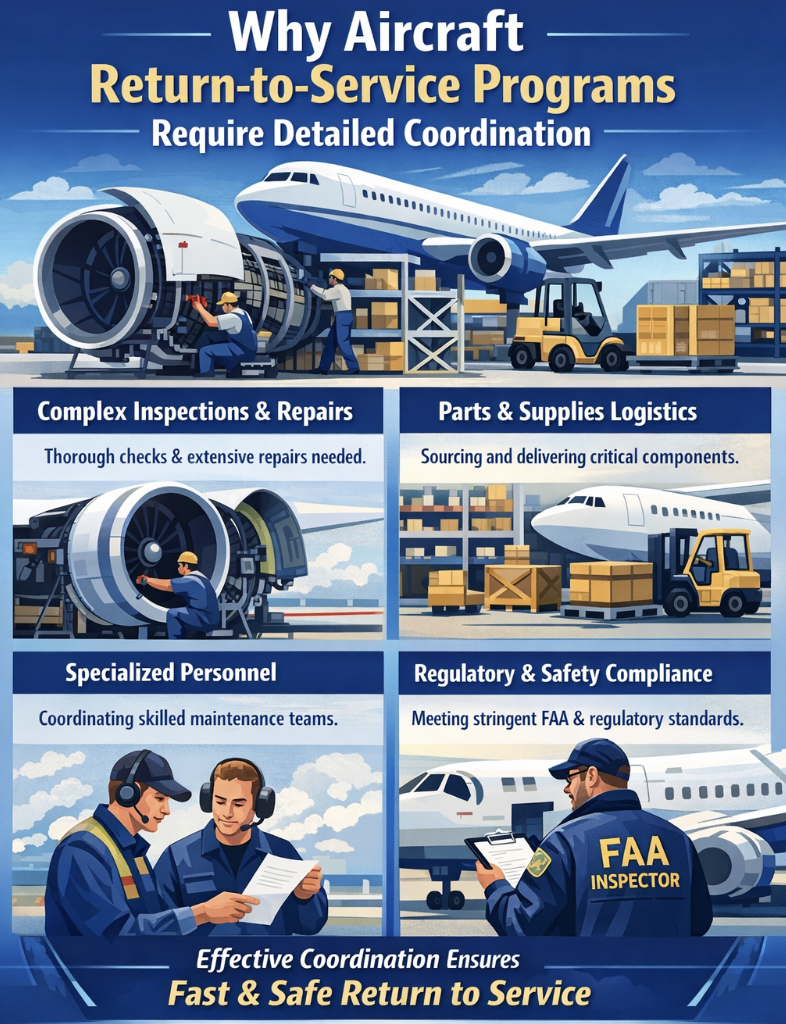
Aircraft return-to-service (RTS) programs are among the most complex technical operations in commercial aviation. When an aircraft has been placed in storage—whether for several months or several years—bringing it back into active service requires extensive inspections, maintenance activities, documentation review, and regulatory compliance verification.
Returning an aircraft to operational status is not a single maintenance task. It is a multi-stage process involving numerous teams, technical disciplines, and organizations. Airlines, maintenance repair organizations (MROs), engineering departments, regulatory authorities, and aircraft owners must all work together to ensure that the aircraft is safe and compliant before it returns to flight operations.
Because of the number of moving parts involved, aircraft return-to-service programs require detailed coordination and oversight. Many operators rely on experienced aviation technical service providers such as Air Viper LLC to assist with technical representation and coordination during these complex reactivation programs.
Understanding why coordination is essential helps explain how airlines safely and efficiently reactivate stored aircraft.
The Complexity of Aircraft Reactivation
Aircraft are highly sophisticated machines composed of thousands of interconnected systems and components. During storage, many of these systems are preserved, deactivated, or protected to prevent deterioration.
When the aircraft is reactivated, each of these systems must be carefully inspected, restored, and tested before the aircraft can safely return to service.
The reactivation process may involve:
- Storage exit inspections
- System reactivation procedures
- Engine inspections and testing
- Maintenance task completion
- Component replacements
- Regulatory compliance verification
- Documentation review
- Functional testing and operational checks
Because each step depends on the completion of others, coordination is critical to ensure that tasks are performed in the correct order.
Multiple Stakeholders Involved in RTS Programs
Aircraft return-to-service programs involve a wide range of aviation stakeholders. Each organization plays a specific role in the process.
Without effective communication and coordination between these parties, the program can quickly become disorganized.
Airline Technical Operations Teams
The airline’s technical operations department typically leads the return-to-service program.
These teams manage:
- maintenance planning
- engineering support
- system reactivation procedures
- documentation review
- operational readiness
They ensure that the aircraft meets the airline’s internal operational standards.
Maintenance Repair Organizations (MROs)
Many airlines rely on MRO facilities to perform maintenance work during aircraft reactivation.
These facilities provide technicians, equipment, and hangar space needed to perform inspections and maintenance tasks.
MROs are responsible for completing the maintenance procedures required for return-to-service.
Aircraft Lessors and Asset Managers
If the aircraft is leased, the lessor or asset manager may also be involved in the return-to-service process.
Aircraft owners often want to verify that maintenance activities are performed correctly and that the aircraft remains in acceptable technical condition.
They may assign technical representatives to monitor the process.
Regulatory Authorities
Aviation regulatory authorities establish the rules governing aircraft airworthiness and maintenance.
Aircraft returning from storage must meet all applicable regulatory requirements before returning to service.
Regulators may review maintenance records, inspections, and documentation as part of this process.
Technical Representatives
Technical representatives provide oversight and coordination between stakeholders during return-to-service programs.
These professionals help monitor maintenance activities, verify compliance, and ensure that inspections and documentation meet required standards.
Technical service providers such as Air Viper LLC often supply experienced representatives who assist with these responsibilities.
Coordinating Maintenance Planning
One of the first coordination challenges in an RTS program is maintenance planning.
Aircraft reactivation involves numerous maintenance tasks that must be carefully scheduled and sequenced.
Reviewing Maintenance Status
Maintenance planners must evaluate the aircraft’s current maintenance status to determine which inspections and tasks are required.
This review includes:
- aircraft maintenance history
- component life limits
- Airworthiness Directive compliance
- Service Bulletin status
- scheduled inspection intervals
Once planners understand the aircraft’s maintenance condition, they can develop a maintenance plan for the reactivation program.
Scheduling Maintenance Tasks
Maintenance tasks must be scheduled in a logical sequence.
For example, technicians may need to:
- Remove storage preservation materials
- Conduct storage exit inspections
- Reactivate aircraft systems
- Perform engine inspections
- Complete required maintenance tasks
- Conduct functional tests
If tasks are scheduled incorrectly, technicians may need to repeat inspections or delay other maintenance activities.
Effective coordination ensures that the work progresses efficiently.
Coordinating Aircraft Inspections
Aircraft reactivation involves numerous inspections across multiple technical areas.
These inspections often require coordination between different specialists.
Structural Inspections
Airframe technicians inspect the aircraft structure for signs of corrosion, damage, or environmental contamination.
These inspections may focus on:
- fuselage surfaces
- wings and control surfaces
- landing gear assemblies
- wheel wells
- cargo compartments
If structural issues are discovered, engineering teams may need to evaluate the findings before repairs can proceed.
System Inspections
Aircraft systems must be inspected and tested before they can be reactivated.
These systems include:
- hydraulic systems
- electrical systems
- fuel systems
- environmental control systems
- avionics equipment
Technicians responsible for each system must coordinate their activities to ensure proper sequencing.
Engine Inspections
Aircraft engines require careful inspection during reactivation.
Preservation materials must be removed, internal inspections conducted, and engine performance tested during ground runs.
Engine specialists often work alongside maintenance teams and engineers to perform these tasks.
Managing Maintenance Resources
Another important coordination challenge involves managing maintenance resources.
Aircraft reactivation programs require access to specialized personnel, equipment, and facilities.
Hangar Availability
Maintenance work often requires indoor hangar space.
Airlines must coordinate with maintenance facilities to schedule hangar access for the aircraft.
Limited hangar availability can delay maintenance schedules if not properly planned.
Technician Availability
Aircraft reactivation requires technicians with specialized expertise in different systems.
Maintenance planners must ensure that qualified personnel are available for tasks involving:
- avionics
- engines
- hydraulics
- electrical systems
- structural inspections
Proper workforce coordination helps avoid scheduling conflicts.
Equipment and Tooling
Some maintenance procedures require specialized tools and testing equipment.
These resources must be available when needed to prevent maintenance delays.
Coordinating Parts and Component Logistics
Aircraft reactivation often requires replacement parts and components.
These may include:
- batteries
- tires
- filters
- hydraulic seals
- avionics components
Parts planning is an important coordination task because supply chain delays can significantly impact project timelines.
Maintenance planners must ensure that required components are ordered and delivered before maintenance tasks begin.
Coordinating Documentation and Recordkeeping
Aircraft return-to-service programs generate extensive documentation.
All inspections, maintenance tasks, and system tests must be properly recorded.
Maintenance Documentation
Maintenance documentation may include:
- work orders and task cards
- inspection reports
- maintenance logbook entries
- component installation records
- system test documentation
These records confirm that maintenance activities were completed according to approved procedures.
Compliance Documentation
Aircraft must also demonstrate compliance with regulatory requirements.
This includes documentation confirming:
- Airworthiness Directive compliance
- Service Bulletin implementation
- component life limit tracking
- maintenance release certification
Proper documentation coordination ensures that all records are complete before the aircraft returns to service.
Coordinating Functional Testing
After maintenance tasks are completed, aircraft systems must be tested to verify operational performance.
These functional tests must be coordinated across multiple technical teams.
Examples of functional tests include:
- flight control movement checks
- hydraulic system testing
- electrical system verification
- navigation and communication system testing
- cabin pressurization checks
Technicians and engineers must coordinate these tests to ensure that systems are evaluated correctly.
Operational Readiness and Final Checks
Before the aircraft can return to operational service, airlines perform final readiness checks.
These checks may include:
- engine ground runs
- aircraft taxi tests
- safety equipment inspections
- navigation system verification
Some aircraft reactivation programs also involve operational test flights.
During these flights, pilots and engineers evaluate aircraft performance under real flight conditions.
Successful completion of these checks confirms that the aircraft is ready to resume operations.
The Role of Technical Oversight
Because aircraft reactivation programs involve so many stakeholders and technical tasks, independent technical oversight can be extremely valuable.
Technical representatives help coordinate activities, monitor maintenance progress, and verify that inspections and documentation meet required standards.
Their responsibilities may include:
- observing maintenance activities
- reviewing technical documentation
- monitoring project timelines
- identifying potential issues early
- facilitating communication between stakeholders
Organizations such as Air Viper LLC provide experienced technical representatives who support airlines, lessors, and asset managers during aircraft return-to-service programs.
Their oversight helps improve transparency and coordination throughout the process.
Challenges That Make Coordination Essential
Several challenges can complicate aircraft reactivation programs.
Unexpected Maintenance Findings
Inspections may reveal corrosion, contamination, or component failures that require additional repairs.
These findings must be evaluated by engineering teams and incorporated into the maintenance plan.
Scheduling Conflicts
Limited maintenance facility availability or technician scheduling conflicts can delay the program.
Coordination helps ensure that resources are allocated efficiently.
Supply Chain Delays
Replacement parts may take time to obtain.
Maintenance planners must monitor parts availability and adjust schedules accordingly.
Air Viper LLC Technical Services
Air Viper LLC provides technical services that support aircraft operators, leasing companies, and aviation asset managers during aircraft return-to-service programs.
Their services may include:
- technical representation during aircraft reactivation
- inspection oversight and coordination
- maintenance planning support
- aircraft records review
- lease transition technical services
By providing experienced aviation professionals, Air Viper LLC helps stakeholders manage complex aircraft reactivation programs with improved coordination and technical oversight.
Conclusion
Aircraft return-to-service programs require detailed coordination because of the complexity of aircraft systems, the number of stakeholders involved, and the strict regulatory requirements governing aviation maintenance.
Successful reactivation programs depend on effective communication, careful planning, and precise execution of maintenance tasks.
From coordinating inspections and maintenance schedules to managing parts logistics and documentation review, each aspect of the process must be carefully managed.
Technical oversight from experienced aviation service providers such as Air Viper LLC can help airlines and aircraft owners manage these programs more efficiently.
With proper coordination, stored aircraft can safely and reliably return to active service while maintaining the highest standards of safety, compliance, and operational readiness.
Contact Air Viper, LLC
Air Viper, LLC provides independent aircraft technical representation, maintenance oversight, aircraft records support, and lease transition services for aircraft owners, operators, and leasing companies. We help ensure aircraft maintenance events, inspections, and technical projects are completed correctly while protecting the long-term value of the asset.
To discuss your aircraft project, contact our team:
Phone: +1 (918) -524-9380
Email: [email protected]
Air Viper, LLC’s Founder

Forrest Ludwig is a dynamic entrepreneur with a passion for aviation parts supply, customer service, and business innovation. With a keen eye for efficiency and precision, he has dedicated his career to connecting operators, MROs, and aviation professionals with the right parts at the right time—minimizing downtime and maximizing operational success.
A true believer in customer-first solutions, Forrest has built a reputation for delivering exceptional service, transparency, and reliability in the aviation industry. His expertise spans aviation parts sourcing, logistics, supply chain optimization, and aircraft sales & leasing, ensuring clients receive cost-effective and high-quality solutions tailored to their needs.
With a forward-thinking approach and a commitment to excellence, Forrest continues to revolutionize aviation parts supply by streamlining processes, enhancing customer experience, and creating innovative solutions for a rapidly evolving industry.
Passionate about aviation. Dedicated to service. Committed to keeping fleets in the air.
Learn More About The Rest Of Our Team!
Why Airlines, Lessors, and MROs Choose Air Viper, LLC
Air Viper, LLC provides aviation parts sourcing, aircraft inspection services, and aircraft transaction support for operators worldwide. Customers work with Air Viper, LLC because the company focuses on efficiency, reliability, and industry expertise.
1. Global Aircraft Parts Sourcing
Air Viper, LLC helps operators locate aircraft components through an international supplier network, including hard-to-find parts.
2. Efficient Direct Shipping
Components can be shipped directly to customers using their preferred courier, reducing handling time and delivery delays.
3. Access to Critical Aircraft Components
Air Viper, LLC assists with sourcing major components such as aircraft engines, auxiliary power units (APUs), and landing gear.
4. Global Supplier Network
Through relationships with aviation suppliers worldwide, Air Viper, LLC helps customers access inventory across multiple markets.
5. Aircraft and Engine Inspection Services
Air Viper, LLC provides on-site aircraft and engine inspection support for aircraft purchases, lease transitions, and technical evaluations.
6. Aircraft Sales and Leasing Support
Air Viper, LLC connects buyers, sellers, and lessors to help facilitate aircraft sales and leasing opportunities.
7. Aviation Logistics Coordination
Air Viper, LLC helps coordinate the logistics of aircraft components, simplifying the procurement and delivery process.
8. Aviation Industry Experience
With experience in aviation parts sourcing, logistics, and aircraft inspections, Air Viper, LLC understands the operational needs of airlines, lessors, and maintenance organizations.
9. Faster Response for Time-Sensitive Needs
When aircraft operators need parts or inspection support quickly, Air Viper, LLC focuses on providing efficient responses and sourcing solutions.
10. Supporting Aircraft Operations Worldwide
Air Viper, LLC works with aviation operators around the world to help support safe and efficient aircraft operations.