
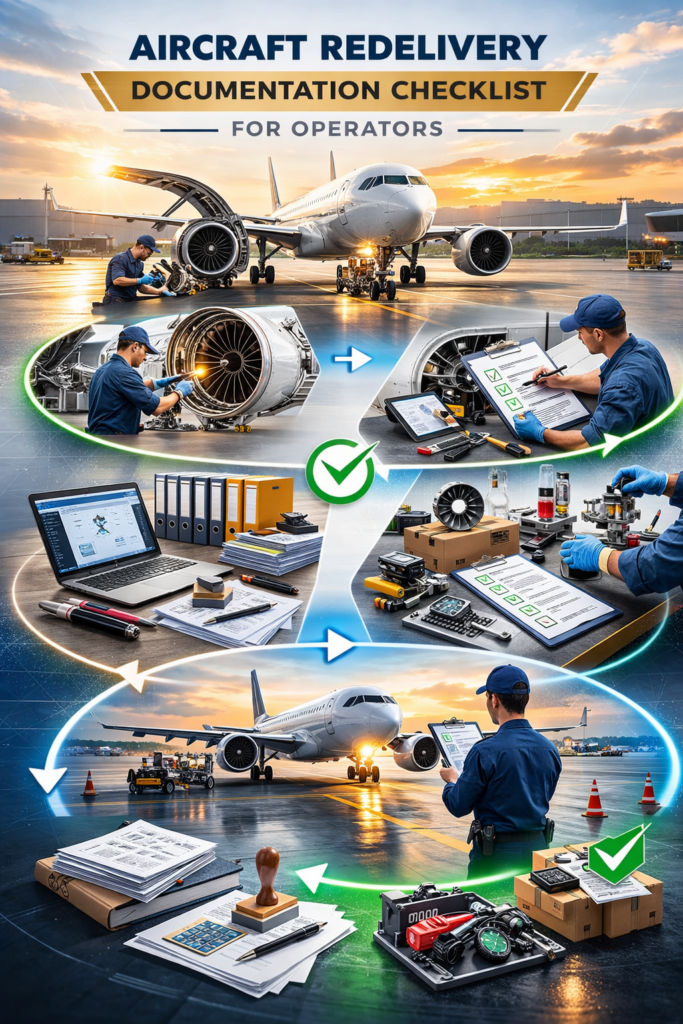
Aircraft redelivery is one of the most documentation-intensive processes in aviation. When a lease ends, airlines must return the aircraft to the leasing company with a complete and verifiable record of the aircraft’s maintenance history, configuration, and airworthiness status. These records are essential for proving that the aircraft has been maintained according to regulatory requirements and the conditions specified in the lease agreement.
Incomplete or poorly organized documentation is one of the most common causes of aircraft redelivery delays. Lessors require detailed records to ensure the aircraft can be placed with another operator without regulatory or maintenance issues. For this reason, airlines must prepare a comprehensive documentation package that allows the lessor and future operators to review the aircraft’s technical history quickly and accurately.
This article provides a detailed aircraft redelivery documentation checklist for operators, outlining the key records required during lease transitions and explaining how airlines typically organize and prepare these materials.
Why Aircraft Redelivery Documentation Matters
Aircraft documentation provides a complete historical record of an aircraft’s technical condition and maintenance history. Without proper documentation, it is impossible to verify whether the aircraft meets airworthiness requirements.
During aircraft lease returns, lessors require documentation to confirm:
- Compliance with regulatory requirements
- Adherence to the approved maintenance program
- Completion of mandatory inspections and repairs
- Accurate tracking of life-limited components
- Compliance with airworthiness directives and service bulletins
Aircraft documentation also protects the long-term value of the aircraft. A complete technical record allows the aircraft to transition smoothly to a new operator.
Poor documentation can result in:
- Redelivery delays
- Additional records reconstruction work
- Financial penalties or settlements
- Increased maintenance verification requirements
For these reasons, documentation preparation often begins one to two years before the lease expiration date.
Aircraft Status and Overview Documents
The first section of a redelivery documentation package typically provides a high-level overview of the aircraft’s technical status.
These documents allow the lessor to quickly understand the condition of the aircraft and confirm compliance with lease return conditions.
Key documents include:
- Aircraft status summary report
- Total aircraft flight hours and cycles
- Maintenance program summary
- Aircraft configuration report
- Aircraft modification summary
These documents help establish the baseline technical condition of the aircraft and provide a starting point for deeper technical reviews.
Airframe Maintenance Records
Airframe maintenance records document all inspections, repairs, and structural maintenance performed on the aircraft throughout its operational life.
These records verify that the aircraft has been maintained according to its approved maintenance program.
Important airframe records include:
- Aircraft logbooks
- Scheduled maintenance task completion records
- Structural repair documentation
- Corrosion inspection reports
- Non-routine maintenance reports
These records must show clear traceability from the aircraft’s delivery date through the end of the lease period.
Lessors will often review these documents carefully to ensure there are no missing maintenance intervals or undocumented repairs.
Airworthiness Directive Compliance Records
Airworthiness Directives (ADs) are mandatory safety regulations issued by aviation authorities such as the Federal Aviation Administration (FAA) or the European Union Aviation Safety Agency (EASA).
Aircraft redelivery documentation must include proof that all applicable ADs have been complied with.
Typical AD documentation includes:
- AD status reports
- Compliance documentation
- Method of compliance records
- Repetitive inspection tracking records
The AD compliance report must show that all directives applicable to the aircraft, engines, and components have been addressed.
Incomplete AD documentation is one of the most common redelivery discrepancies identified during records audits.
Service Bulletin Compliance Documentation
Service bulletins (SBs) are manufacturer-issued maintenance recommendations or modifications.
Although not all service bulletins are mandatory, many lease agreements require airlines to document which bulletins have been incorporated.
Documentation typically includes:
- Service bulletin status list
- Compliance documentation
- Engineering approvals for incorporated modifications
Lessors often require airlines to provide a clear summary of all major service bulletins incorporated during the lease period.
Component Traceability and Installation Records
Aircraft contain thousands of individual components that must be tracked throughout their service life.
Component traceability records verify the installation history, service life, and maintenance status of these parts.
Required documentation may include:
- Component installation history reports
- Removal and installation records
- Authorized release certificates (such as FAA Form 8130-3 or EASA Form 1)
- Repair and overhaul records
These records confirm that all components installed on the aircraft meet regulatory and maintenance requirements.
Life-limited components, such as landing gear parts and engine components, require especially careful documentation.
Engine and APU Documentation
Engines and Auxiliary Power Units (APUs) are among the most valuable components on an aircraft. As a result, their documentation requirements are extensive.
Engine and APU documentation typically includes:
- Engine logbooks
- Engine flight hour and cycle summaries
- Life-limited part tracking records
- Engine shop visit reports
- Engine performance data
- APU maintenance records
Lessors will review engine documentation to confirm that engines meet the lease return conditions regarding remaining life and performance margins.
Incomplete engine documentation can significantly delay aircraft redelivery.
Landing Gear Documentation
Landing gear systems have specific maintenance and overhaul intervals that must be documented during the lease period.
Required landing gear records include:
- Landing gear installation records
- Overhaul documentation
- Life-limited part tracking
- Inspection reports
Because landing gear overhauls occur on long intervals, lessors pay close attention to the remaining life of these components when reviewing redelivery documentation.
Modification and Repair Documentation
Aircraft frequently undergo modifications and structural repairs during their operational life.
All modifications and repairs must be properly documented and approved by the relevant aviation authority or engineering department.
Documentation typically includes:
- Supplemental Type Certificate (STC) documentation
- Engineering orders
- Structural repair approvals
- Modification drawings and instructions
These records confirm that all modifications and repairs were performed according to approved engineering procedures.
Weight and Balance Records
Aircraft weight and balance documentation ensures that the aircraft remains within its certified operational limits.
These records are required to verify that all modifications and equipment installations have been properly accounted for.
Typical documentation includes:
- Aircraft weight and balance reports
- Equipment lists
- Configuration changes
Accurate weight and balance records are especially important if the aircraft has undergone cabin modifications during the lease period.
Aircraft Maintenance Program Compliance
Aircraft must be maintained according to an approved maintenance program that meets regulatory requirements.
Redelivery documentation must demonstrate that the airline adhered to this program throughout the lease period.
Documentation typically includes:
- Maintenance program approval documentation
- Maintenance task compliance reports
- Maintenance interval tracking
This documentation confirms that the aircraft has been maintained in accordance with regulatory and manufacturer requirements.
Aircraft Paint and Appearance Records
Lease agreements often include requirements related to the aircraft’s exterior appearance.
Airlines may be required to provide documentation showing that paint maintenance or repainting has been performed according to lease conditions.
Relevant documentation may include:
- Paint condition reports
- Repainting records
- Corrosion inspection documentation
These records help confirm that the aircraft meets cosmetic and structural return requirements.
Digital Records and Data Organization
Many airlines now maintain aircraft records in digital formats rather than traditional paper logbooks.
Digital record systems make it easier to organize and review documentation during the lease return process.
However, airlines must ensure that digital records:
- Are complete and accessible
- Follow industry documentation standards
- Can be easily reviewed by lessor representatives
Some lessors require records to be provided in specific digital formats or document management systems.
Proper digital organization can significantly speed up the redelivery review process.
Conducting a Records Audit Before Redelivery
Before the aircraft is returned to the lessor, airlines typically conduct an internal records audit.
This audit identifies any missing documentation or inconsistencies that could cause delays during the official redelivery review.
Records audits typically focus on:
- Missing component documentation
- Incomplete maintenance records
- Missing repair approvals
- Incorrect logbook entries
By identifying these issues early, airlines can correct them before the lessor conducts their own audit.
Best Practices for Redelivery Documentation Preparation
Preparing documentation for aircraft redelivery is a long and detailed process.
Airlines that manage the process effectively typically follow several best practices.
These include:
- Starting documentation preparation early
- Maintaining organized digital record systems
- Assigning dedicated records specialists
- Conducting periodic documentation reviews during the lease period
- Coordinating closely with lessor technical representatives
These practices help ensure that the aircraft documentation package is complete and ready for review when the lease ends.
Conclusion
Aircraft redelivery documentation plays a critical role in ensuring a smooth lease transition. Complete and accurate records allow lessors to verify that the aircraft has been properly maintained and meets all contractual return conditions.
The documentation package for aircraft redelivery typically includes airframe maintenance records, airworthiness directive compliance documentation, service bulletin records, component traceability reports, engine and APU documentation, modification approvals, and weight and balance records.
Because documentation discrepancies are one of the most common causes of redelivery delays, airlines must begin preparing records well in advance of the lease expiration date. Careful organization, internal records audits, and coordination with lessor representatives help ensure that the aircraft can be returned efficiently and without costly delays.
Contact Air Viper, LLC
Air Viper, LLC provides independent aircraft technical representation, maintenance oversight, aircraft records support, and lease transition services for aircraft owners, operators, and leasing companies. We help ensure aircraft maintenance events, inspections, and technical projects are completed correctly while protecting the long-term value of the asset.
To discuss your aircraft project, contact our team:
Phone: +1 (918) -524-9380
Email: [email protected]
Air Viper, LLC’s Founder

Forrest Ludwig is a dynamic entrepreneur with a passion for aviation parts supply, customer service, and business innovation. With a keen eye for efficiency and precision, he has dedicated his career to connecting operators, MROs, and aviation professionals with the right parts at the right time—minimizing downtime and maximizing operational success.
A true believer in customer-first solutions, Forrest has built a reputation for delivering exceptional service, transparency, and reliability in the aviation industry. His expertise spans aviation parts sourcing, logistics, supply chain optimization, and aircraft sales & leasing, ensuring clients receive cost-effective and high-quality solutions tailored to their needs.
With a forward-thinking approach and a commitment to excellence, Forrest continues to revolutionize aviation parts supply by streamlining processes, enhancing customer experience, and creating innovative solutions for a rapidly evolving industry.
Passionate about aviation. Dedicated to service. Committed to keeping fleets in the air.
Learn More About The Rest Of Our Team!
Why Airlines, Lessors, and MROs Choose Air Viper, LLC
Air Viper, LLC provides aviation parts sourcing, aircraft inspection services, and aircraft transaction support for operators worldwide. Customers work with Air Viper, LLC because the company focuses on efficiency, reliability, and industry expertise.
1. Global Aircraft Parts Sourcing
Air Viper, LLC helps operators locate aircraft components through an international supplier network, including hard-to-find parts.
2. Efficient Direct Shipping
Components can be shipped directly to customers using their preferred courier, reducing handling time and delivery delays.
3. Access to Critical Aircraft Components
Air Viper, LLC assists with sourcing major components such as aircraft engines, auxiliary power units (APUs), and landing gear.
4. Global Supplier Network
Through relationships with aviation suppliers worldwide, Air Viper, LLC helps customers access inventory across multiple markets.
5. Aircraft and Engine Inspection Services
Air Viper, LLC provides on-site aircraft and engine inspection support for aircraft purchases, lease transitions, and technical evaluations.
6. Aircraft Sales and Leasing Support
Air Viper, LLC connects buyers, sellers, and lessors to help facilitate aircraft sales and leasing opportunities.
7. Aviation Logistics Coordination
Air Viper, LLC helps coordinate the logistics of aircraft components, simplifying the procurement and delivery process.
8. Aviation Industry Experience
With experience in aviation parts sourcing, logistics, and aircraft inspections, Air Viper, LLC understands the operational needs of airlines, lessors, and maintenance organizations.
9. Faster Response for Time-Sensitive Needs
When aircraft operators need parts or inspection support quickly, Air Viper, LLC focuses on providing efficient responses and sourcing solutions.
10. Supporting Aircraft Operations Worldwide
Air Viper, LLC works with aviation operators around the world to help support safe and efficient aircraft operations.