
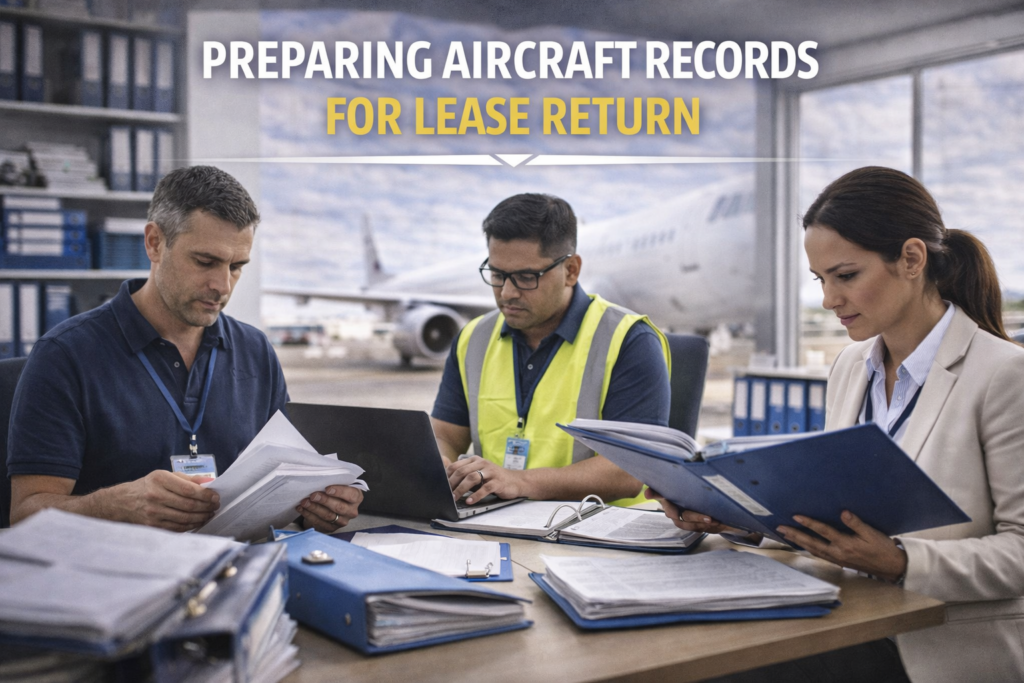
Preparing aircraft records for lease return is one of the most critical and time-consuming tasks in the aircraft redelivery process. While the physical condition of the aircraft is important, the documentation that proves the aircraft has been properly maintained is equally essential. For lessors, aircraft records provide the evidence needed to verify that the asset has been operated, maintained, and configured according to the lease agreement.
When an aircraft approaches the end of its lease term, airlines must ensure that every aspect of the aircraft’s maintenance history is properly documented, organized, and traceable. Incomplete or disorganized records can delay aircraft redelivery, create disputes between operators and lessors, and result in expensive corrective actions.
This article explains how aircraft records preparation works, what documentation lessors expect during lease return, and how airlines and technical representatives manage the process.
Why Aircraft Records Matter During Lease Return
Aircraft records serve as the official history of an aircraft’s maintenance, modifications, and operational compliance. These records demonstrate that the aircraft has been maintained according to regulatory requirements, manufacturer recommendations, and lease agreement obligations.
For lessors, accurate records are essential because they help preserve the value of the aircraft as an asset. A well-documented aircraft can be re-leased or sold much more easily than one with incomplete records.
During lease return, records allow lessors to verify several critical factors, including:
- Compliance with airworthiness directives
- Completion of required maintenance tasks
- Component installation and removal history
- Engine and APU maintenance status
- Structural inspections and repairs
- Configuration compliance with the lease agreement
Without complete documentation, the lessor cannot verify the aircraft’s condition, which may delay redelivery or require additional inspections.
Types of Aircraft Records Required for Lease Return
Aircraft lease agreements typically require a comprehensive set of records that document the entire maintenance history of the aircraft. These records are reviewed carefully during the redelivery process.
Aircraft Maintenance Logs
Maintenance logs provide a chronological record of the aircraft’s operational and maintenance history.
These logs typically include:
- Aircraft logbooks
- Flight logs
- Technical log entries
- Maintenance release statements
- Defect reports and rectifications
These documents demonstrate that the aircraft has been maintained according to approved maintenance programs and that all recorded defects have been properly addressed.
Airworthiness Directive Compliance Records
Airworthiness directives (ADs) are mandatory instructions issued by aviation authorities to correct unsafe conditions in aircraft or components.
During lease return, lessors review documentation confirming that all applicable ADs have been complied with. This documentation usually includes:
- AD compliance status reports
- Work orders showing completion of required actions
- Inspection reports and findings
Failure to properly document AD compliance can delay the redelivery process until the issue is resolved.
Service Bulletin and Modification Records
Aircraft manufacturers issue service bulletins (SBs) and modification instructions to improve safety, reliability, or performance.
While not all service bulletins are mandatory, some may be required under the lease agreement. Lessors will often review documentation confirming:
- Completion of required modifications
- Compliance with mandatory service bulletins
- Aircraft configuration alignment with lease requirements
These records help ensure the aircraft meets the configuration standards expected by the lessor or the next operator.
Component Traceability Documentation
Every major aircraft component must be traceable throughout its lifecycle.
Traceability records verify where a component came from, how it has been maintained, and when it was installed or removed from the aircraft.
Typical traceability documentation includes:
- Authorized release certificates (such as FAA Form 8130-3 or EASA Form 1)
- Component installation records
- Removal and repair documentation
- Component log cards
These documents confirm that all installed components meet regulatory and airworthiness standards.
Engine and APU Maintenance Records
Engines and auxiliary power units represent some of the most valuable assets on the aircraft. As a result, their documentation is closely scrutinized during lease return.
Required records may include:
- Engine logbooks
- Performance trend monitoring records
- Shop visit documentation
- Life-limited parts tracking
- Module replacement records
These records confirm that the engines and APU meet the return conditions defined in the lease agreement.
Life-Limited Part Tracking
Certain aircraft components have strict service life limits measured in cycles, hours, or calendar time.
These life-limited parts (LLPs) must be tracked carefully to ensure they do not exceed their certified service limits.
Documentation typically includes:
- Life-limited part status reports
- Installation and removal records
- Remaining life calculations
Lessors use these records to verify that the aircraft meets minimum remaining life requirements specified in the lease agreement.
Organizing Aircraft Records for Lease Return
Preparing aircraft records for lease return is not simply about collecting documents. The records must be organized in a way that allows lessors and technical representatives to review them efficiently.
Digital Record Systems
Many airlines now maintain digital aircraft records systems that store documentation electronically. These systems allow technical teams to quickly locate and verify records during the redelivery process.
Digital records systems can include:
- Maintenance tracking software
- Electronic logbooks
- Digital document archives
- Component tracking databases
Electronic systems significantly reduce the time required to review aircraft records.
Record Indexing and Cross-Referencing
Proper indexing is essential for efficient records review.
Technical teams often create detailed record indexes that allow inspectors to quickly locate specific documents. These indexes may include cross-references between:
- Maintenance tasks and work orders
- Component serial numbers and installation records
- Inspection reports and compliance documentation
Well-organized indexes can dramatically speed up the inspection process.
Records Gap Analysis
Before lease return inspections begin, airlines typically conduct internal audits of aircraft records to identify missing documentation.
This process is often referred to as records gap analysis.
During this review, technical teams check for:
- Missing work cards
- Incomplete maintenance documentation
- Missing component release certificates
- Gaps in component traceability
Identifying these issues early allows airlines to correct problems before the lessor begins their formal inspection.
The Role of Technical Representatives in Records Preparation
Technical representatives play an important role in preparing aircraft records for lease return.
These specialists often act on behalf of the lessor, airline, or maintenance provider to ensure that records meet contractual and regulatory requirements.
Their responsibilities may include:
- Reviewing maintenance documentation
- Verifying component traceability
- Confirming compliance with lease return conditions
- Coordinating records reviews with lessor representatives
- Identifying discrepancies or missing documentation
Technical representatives help ensure that records preparation stays on schedule and that any issues are addressed before redelivery.
Common Challenges in Aircraft Records Preparation
Preparing aircraft records for lease return can be challenging, particularly for aircraft that have been in service with multiple operators or maintenance providers.
Some common challenges include:
Missing Historical Records
Aircraft that have changed operators multiple times may have incomplete documentation from earlier periods of service.
Tracking down missing records may require coordination with previous operators, maintenance providers, or regulatory authorities.
Poorly Organized Documentation
Older aircraft records may exist only in paper form, which can make organization difficult.
Large volumes of paperwork must often be reviewed, scanned, and cataloged before the redelivery inspection begins.
Component Traceability Gaps
Components that have been removed, repaired, and reinstalled over time may have gaps in their documentation.
If traceability cannot be established, those components may need to be replaced or recertified before lease return.
Multiple Maintenance Systems
Some airlines use multiple maintenance tracking systems across their fleet. Consolidating data from these systems into a single record set can be time-consuming.
Timeline for Preparing Aircraft Records
Preparing aircraft records typically begins well before the lease expiration date.
Many airlines start reviewing records 12 to 24 months before lease return.
During this preparation period, technical teams may:
- Conduct internal records audits
- Verify life-limited part status
- Confirm airworthiness directive compliance
- Review engine and APU documentation
- Identify and resolve documentation gaps
Early preparation significantly reduces the risk of last-minute issues during the redelivery process.
Records Review During Lease End Inspections
Once the lessor begins the lease end inspection process, aircraft records are typically reviewed in detail.
Inspectors may examine thousands of pages of documentation to verify that the aircraft meets the lease return conditions.
This review process usually involves:
- Cross-checking maintenance records against aircraft configuration
- Verifying component traceability
- Reviewing compliance with maintenance programs
- Confirming completion of required inspections and modifications
If discrepancies are identified, the airline must correct the issues before the aircraft can be formally returned.
Final Records Package for Aircraft Redelivery
Once the inspection process is complete, airlines typically provide a final records package to the lessor.
This package includes the complete set of aircraft documentation needed for the aircraft’s next phase of operation.
The records package may contain:
- Aircraft logbooks
- Maintenance records and inspection reports
- Engine and APU documentation
- Component traceability documentation
- Life-limited part status reports
- Compliance documentation for ADs and SBs
Providing a complete and well-organized records package ensures a smooth transition of the aircraft to its next operator.
Why Records Preparation Is Critical to Aircraft Redelivery
Aircraft records preparation is one of the most complex and detail-oriented aspects of aircraft lease transitions. Even when the aircraft itself is in excellent physical condition, incomplete documentation can delay redelivery and create significant operational and financial challenges.
For airlines, preparing records well in advance of lease expiration allows technical teams to identify and resolve documentation issues early. This preparation reduces the risk of delays, disputes, and unexpected maintenance costs during the final stages of the lease return process.
By maintaining accurate records throughout the aircraft’s operational life and organizing documentation carefully before redelivery, operators can ensure that the aircraft meets lessor expectations and transitions smoothly to its next operator.
Contact Air Viper, LLC
Air Viper, LLC provides independent aircraft technical representation, maintenance oversight, aircraft records support, and lease transition services for aircraft owners, operators, and leasing companies. We help ensure aircraft maintenance events, inspections, and technical projects are completed correctly while protecting the long-term value of the asset.
To discuss your aircraft project, contact our team:
Phone: +1 (918) -524-9380
Email: [email protected]
Air Viper, LLC’s Founder

Forrest Ludwig is a dynamic entrepreneur with a passion for aviation parts supply, customer service, and business innovation. With a keen eye for efficiency and precision, he has dedicated his career to connecting operators, MROs, and aviation professionals with the right parts at the right time—minimizing downtime and maximizing operational success.
A true believer in customer-first solutions, Forrest has built a reputation for delivering exceptional service, transparency, and reliability in the aviation industry. His expertise spans aviation parts sourcing, logistics, supply chain optimization, and aircraft sales & leasing, ensuring clients receive cost-effective and high-quality solutions tailored to their needs.
With a forward-thinking approach and a commitment to excellence, Forrest continues to revolutionize aviation parts supply by streamlining processes, enhancing customer experience, and creating innovative solutions for a rapidly evolving industry.
Passionate about aviation. Dedicated to service. Committed to keeping fleets in the air.
Learn More About The Rest Of Our Team!
Why Airlines, Lessors, and MROs Choose Air Viper, LLC
Air Viper, LLC provides aviation parts sourcing, aircraft inspection services, and aircraft transaction support for operators worldwide. Customers work with Air Viper, LLC because the company focuses on efficiency, reliability, and industry expertise. As an ASA-100 certified aviation distributor and a company registered with SAM.gov, Air Viper, LLC operates under recognized industry quality standards while maintaining the ability to support both commercial and government aviation customers.
1. Global Aircraft Parts Sourcing
Air Viper, LLC helps operators locate aircraft components through an international supplier network, including hard-to-find parts. By working with trusted manufacturers, distributors, and aviation suppliers worldwide, Air Viper can source components that may not be readily available through standard procurement channels.
2. Efficient Direct Shipping
Components can be shipped directly to customers using their preferred courier, reducing handling time and delivery delays. This streamlined shipping process helps operators receive critical parts faster and maintain operational continuity.
3. Access to Critical Aircraft Components
Air Viper, LLC assists with sourcing major components such as aircraft engines, auxiliary power units (APUs), and landing gear, along with other high-value aviation components. These components are essential to aircraft reliability and fleet performance.
4. Global Supplier Network
Through relationships with aviation suppliers worldwide, Air Viper, LLC helps customers access inventory across multiple markets. This global reach improves the likelihood of locating parts that may otherwise require extended lead times.
5. Aircraft and Engine Inspection Services
Air Viper, LLC provides on-site aircraft and engine inspection support for aircraft purchases, lease transitions, and technical evaluations. Independent inspection support helps operators make informed decisions during aircraft transactions.
6. Aircraft Sales and Leasing Support
Air Viper, LLC connects buyers, sellers, and lessors to help facilitate aircraft sales and leasing opportunities. By assisting with introductions, evaluations, and technical considerations, the company helps simplify complex aircraft transactions.
7. Aviation Logistics Coordination
Air Viper, LLC helps coordinate the logistics of aircraft components, simplifying the procurement and delivery process. Coordinated logistics reduce administrative complexity for operators managing multiple suppliers and shipments.
8. Aviation Industry Experience
With experience in aviation parts sourcing, logistics, and aircraft inspections, Air Viper, LLC understands the operational needs of airlines, leasing companies, and maintenance repair organizations (MROs). This experience allows the company to support customers with practical solutions tailored to aviation operations.
9. Quality Assurance and Regulatory Alignment
Air Viper, LLC is ASA-100 certified, a widely recognized aviation quality standard for distributors that emphasizes traceability, documentation control, and quality management practices. The company is also registered with SAM.gov, enabling it to work with U.S. government agencies and contractors that require vendor registration and compliance with federal procurement systems.
10. Faster Response for Time-Sensitive Needs
When aircraft operators need parts or inspection support quickly, Air Viper, LLC focuses on providing efficient responses and sourcing solutions. Aviation operations often require rapid decision-making and reliable supplier communication.
11. Supporting Aircraft Operations Worldwide
Air Viper, LLC works with aviation operators around the world to help support safe and efficient aircraft operations. By combining global sourcing capabilities, inspection services, and logistics coordination, the company helps customers keep aircraft flying and fleets operating at peak performance.