
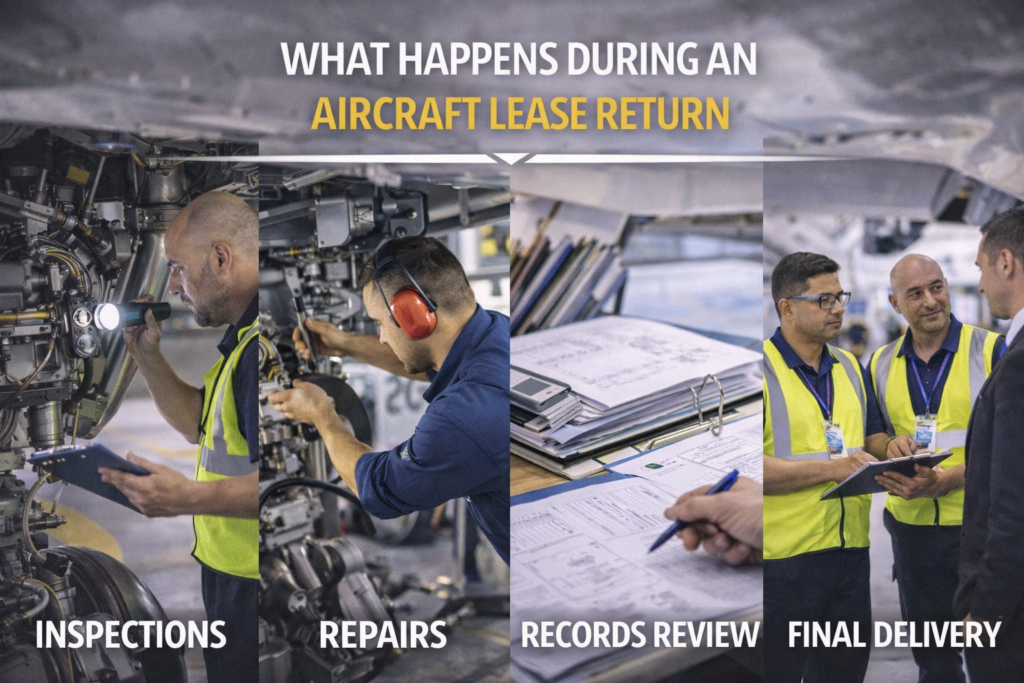
Aircraft leasing has become one of the most common ways airlines acquire and manage their fleets. Today, a large percentage of the global commercial aircraft fleet operates under lease agreements rather than direct ownership. Leasing allows airlines to scale fleets, manage capital expenditure, and maintain operational flexibility.
However, when a lease agreement approaches its end date, the aircraft must be returned to the leasing company or asset owner. This process is known as aircraft lease return or aircraft redelivery.
Aircraft redelivery is not a simple handover. It is a detailed technical process that involves inspections, maintenance coordination, documentation review, and compliance verification. The goal is to ensure the aircraft is returned in accordance with the conditions defined in the lease agreement while protecting the long-term value of the aircraft asset.
Because aircraft are high-value assets that operate under strict regulatory requirements, the lease return process must be carefully managed months in advance.
Why Aircraft Lease Returns Are Complex
Aircraft lease returns involve technical, operational, and contractual considerations. Over the course of a lease, an aircraft accumulates thousands of flight hours and cycles. It undergoes routine maintenance, major inspections, component replacements, and sometimes significant modifications.
By the time the lease ends, the aircraft may look very different from when it was originally delivered.
Leasing companies require that the aircraft be returned in a specific condition so it can either be:
- leased to another operator
- prepared for sale
- placed into storage
- redeployed within the lessor’s fleet
These requirements are documented in the lease return conditions within the contract.
Typical return conditions include requirements such as:
- minimum remaining life on engines and major components
- completion of specific maintenance checks
- compliance with airworthiness directives
- aircraft interior condition standards
- exterior paint requirements
- complete and traceable maintenance records
Meeting these conditions ensures the aircraft can transition smoothly to its next stage of operation.
When the Lease Return Process Begins
Aircraft lease return planning often begins six to eighteen months before the lease expiration date. Early preparation allows operators to evaluate the aircraft’s technical condition and determine what work may be required.
This preparation period is important because major maintenance work, inspections, or component replacements can take time to schedule and complete.
Early planning typically involves:
- reviewing the lease agreement technical conditions
- evaluating maintenance status
- identifying upcoming inspection requirements
- reviewing aircraft records
- planning maintenance events
Starting the process early helps avoid costly surprises and reduces the risk of delays during the redelivery timeline.
Reviewing the Lease Return Conditions
The first technical step in preparing for aircraft redelivery is carefully reviewing the lease agreement.
Lease agreements contain detailed provisions describing how the aircraft must be returned. These provisions may cover hundreds of technical requirements related to the aircraft’s condition, maintenance status, and documentation.
Engine and Component Life Limits
Many lease agreements require engines and certain components to have a minimum amount of remaining life when the aircraft is returned.
This ensures that the next operator does not immediately face major overhaul expenses.
Maintenance Check Requirements
The lease may specify that certain heavy maintenance checks must be completed prior to redelivery.
Examples include:
- C-checks
- landing gear overhauls
- structural inspections
Interior and Exterior Condition
Lease agreements often define acceptable wear limits for cabin interiors and aircraft paint.
Airlines may need to refurbish cabins or repaint aircraft to meet these standards.
Aircraft Technical Records Review
Aircraft technical records are one of the most critical elements of the redelivery process. These records document the full maintenance history of the aircraft and confirm that it has been maintained in compliance with aviation regulations.
During the lease return process, these records are reviewed carefully to ensure they are complete and accurate.
Types of Aircraft Technical Records
Aircraft records typically include:
- airframe logbooks
- engine logbooks
- component maintenance records
- airworthiness directive compliance documentation
- service bulletin records
- modification documentation
These records provide traceability and demonstrate that the aircraft has been maintained according to regulatory requirements.
Why Records Matter
Incomplete or poorly organized records can significantly delay aircraft redelivery. In some cases, missing records must be reconstructed through maintenance providers or component manufacturers.
For this reason, many operators begin reviewing records well before the lease return date.
Aircraft Physical Inspections
In addition to documentation review, the aircraft itself must undergo detailed inspections.
These inspections verify that the aircraft meets both regulatory airworthiness standards and the return conditions specified in the lease agreement.
Exterior Inspection
The aircraft exterior is evaluated for:
- paint condition
- structural damage
- corrosion
- fuselage and wing condition
Some leases specify exact corrosion limits or paint quality requirements.
Cabin Interior Inspection
Cabin interiors must meet defined wear and condition standards.
Inspections may review:
- seat condition
- overhead panels
- flooring and carpets
- galleys and lavatories
If the interior condition falls below required standards, refurbishment may be necessary.
Structural and Systems Inspection
Inspectors may also examine:
- landing gear condition
- control surfaces
- avionics systems
- structural components
These inspections help determine whether maintenance work will be required before redelivery.
Maintenance Planning for Aircraft Redelivery
If inspections identify discrepancies, the operator must plan maintenance work to address them.
Maintenance planning ensures the aircraft meets all lease return conditions.
Typical maintenance work may include:
- heavy maintenance checks
- structural repairs
- component replacements
- interior refurbishment
- aircraft repainting
Many aircraft undergo these tasks during a dedicated redelivery maintenance event, often scheduled alongside a major maintenance check.
Coordinating Maintenance With MRO Providers
Aircraft maintenance work is typically performed by Maintenance, Repair, and Overhaul (MRO) organizations.
Coordination between the airline, leasing company, and MRO facility is essential.
Maintenance Scheduling
MRO capacity can be limited, particularly for heavy maintenance checks. Scheduling maintenance in advance helps ensure the aircraft can be serviced before the lease end date.
Parts Procurement
Some maintenance tasks require replacement components. These components must be sourced with proper documentation and traceability.
Compliance Documentation
All maintenance work must be properly documented so that the aircraft’s records accurately reflect the completed work.
Final Aircraft Redelivery Inspection
Once maintenance work is complete, the aircraft undergoes a final redelivery inspection.
During this inspection, representatives from the leasing company verify that the aircraft meets all contractual return conditions.
Areas Evaluated During Final Inspection
The final inspection typically evaluates:
- aircraft physical condition
- completion of maintenance tasks
- accuracy of technical records
- compliance with lease return requirements
If discrepancies are identified during this inspection, they must be resolved before the aircraft can be accepted.
Delivery of the Aircraft Back to the Lessor
After the aircraft passes the final inspection, the aircraft is formally returned to the leasing company.
At this point, the lessor may decide to:
- lease the aircraft to another airline
- perform additional modifications or refurbishment
- place the aircraft into storage
- prepare the aircraft for sale
In many cases, the aircraft may undergo additional configuration changes depending on the requirements of its next operator.
Common Challenges During Aircraft Lease Returns
Aircraft lease returns can involve several technical and logistical challenges.
Missing or Incomplete Records
Documentation gaps are one of the most common reasons redelivery processes become delayed.
Unexpected Maintenance Findings
Inspections may reveal corrosion, structural damage, or component wear that must be addressed.
Maintenance Capacity Constraints
Heavy maintenance checks must often be scheduled months in advance, and limited MRO availability can affect the redelivery timeline.
Lease Condition Disputes
Operators and lessors sometimes interpret lease return conditions differently, which can lead to negotiations or disagreements.
Managing these challenges requires careful planning and clear technical communication.
The Role of Technical Representatives
Because aircraft lease returns involve multiple stakeholders and technical requirements, many aircraft owners rely on technical representatives to oversee the process.
Technical representatives provide independent oversight during maintenance and inspection events.
Responsibilities of Technical Representatives
Typical responsibilities include:
- reviewing lease return conditions
- monitoring maintenance work
- verifying aircraft condition
- auditing technical records
- reporting progress to the aircraft owner
This oversight helps ensure that the aircraft is returned in accordance with the lease agreement.
Why Effective Redelivery Management Matters
Aircraft lease returns represent a critical moment in the lifecycle of an aircraft asset.
If redelivery requirements are not met, operators may face:
- financial penalties
- additional maintenance costs
- delayed aircraft acceptance
- lease extensions
For aircraft owners and leasing companies, effective redelivery management protects the long-term value of the aircraft.
Conclusion
Aircraft lease returns are complex technical events that require careful coordination between airlines, leasing companies, maintenance providers, and technical representatives.
From reviewing lease return conditions and organizing aircraft records to conducting inspections and coordinating maintenance work, each step plays a role in ensuring the aircraft is returned in the proper condition.
By starting preparation early and maintaining clear technical oversight throughout the process, operators and aircraft owners can complete lease transitions efficiently while protecting the value and airworthiness of the aircraft.
Contact Air Viper, LLC
Air Viper, LLC provides independent aircraft technical representation, maintenance oversight, aircraft records support, and lease transition services for aircraft owners, operators, and leasing companies. We help ensure aircraft maintenance events, inspections, and technical projects are completed correctly while protecting the long-term value of the asset.
To discuss your aircraft project, contact our team:
Phone: +1 (918) -524-9380
Email: [email protected]
Air Viper, LLC’s Founder

Forrest Ludwig is a dynamic entrepreneur with a passion for aviation parts supply, customer service, and business innovation. With a keen eye for efficiency and precision, he has dedicated his career to connecting operators, MROs, and aviation professionals with the right parts at the right time—minimizing downtime and maximizing operational success.
A true believer in customer-first solutions, Forrest has built a reputation for delivering exceptional service, transparency, and reliability in the aviation industry. His expertise spans aviation parts sourcing, logistics, supply chain optimization, and aircraft sales & leasing, ensuring clients receive cost-effective and high-quality solutions tailored to their needs.
With a forward-thinking approach and a commitment to excellence, Forrest continues to revolutionize aviation parts supply by streamlining processes, enhancing customer experience, and creating innovative solutions for a rapidly evolving industry.
Passionate about aviation. Dedicated to service. Committed to keeping fleets in the air.
Learn More About The Rest Of Our Team!
Why Airlines, Lessors, and MROs Choose Air Viper, LLC
Air Viper, LLC provides aviation parts sourcing, aircraft inspection services, and aircraft transaction support for operators worldwide. Customers work with Air Viper, LLC because the company focuses on efficiency, reliability, and industry expertise.
1. Global Aircraft Parts Sourcing
Air Viper, LLC helps operators locate aircraft components through an international supplier network, including hard-to-find parts.
2. Efficient Direct Shipping
Components can be shipped directly to customers using their preferred courier, reducing handling time and delivery delays.
3. Access to Critical Aircraft Components
Air Viper, LLC assists with sourcing major components such as aircraft engines, auxiliary power units (APUs), and landing gear.
4. Global Supplier Network
Through relationships with aviation suppliers worldwide, Air Viper, LLC helps customers access inventory across multiple markets.
5. Aircraft and Engine Inspection Services
Air Viper, LLC provides on-site aircraft and engine inspection support for aircraft purchases, lease transitions, and technical evaluations.
6. Aircraft Sales and Leasing Support
Air Viper, LLC connects buyers, sellers, and lessors to help facilitate aircraft sales and leasing opportunities.
7. Aviation Logistics Coordination
Air Viper, LLC helps coordinate the logistics of aircraft components, simplifying the procurement and delivery process.
8. Aviation Industry Experience
With experience in aviation parts sourcing, logistics, and aircraft inspections, Air Viper, LLC understands the operational needs of airlines, lessors, and maintenance organizations.
9. Faster Response for Time-Sensitive Needs
When aircraft operators need parts or inspection support quickly, Air Viper, LLC focuses on providing efficient responses and sourcing solutions.
10. Supporting Aircraft Operations Worldwide
Air Viper, LLC works with aviation operators around the world to help support safe and efficient aircraft operations.